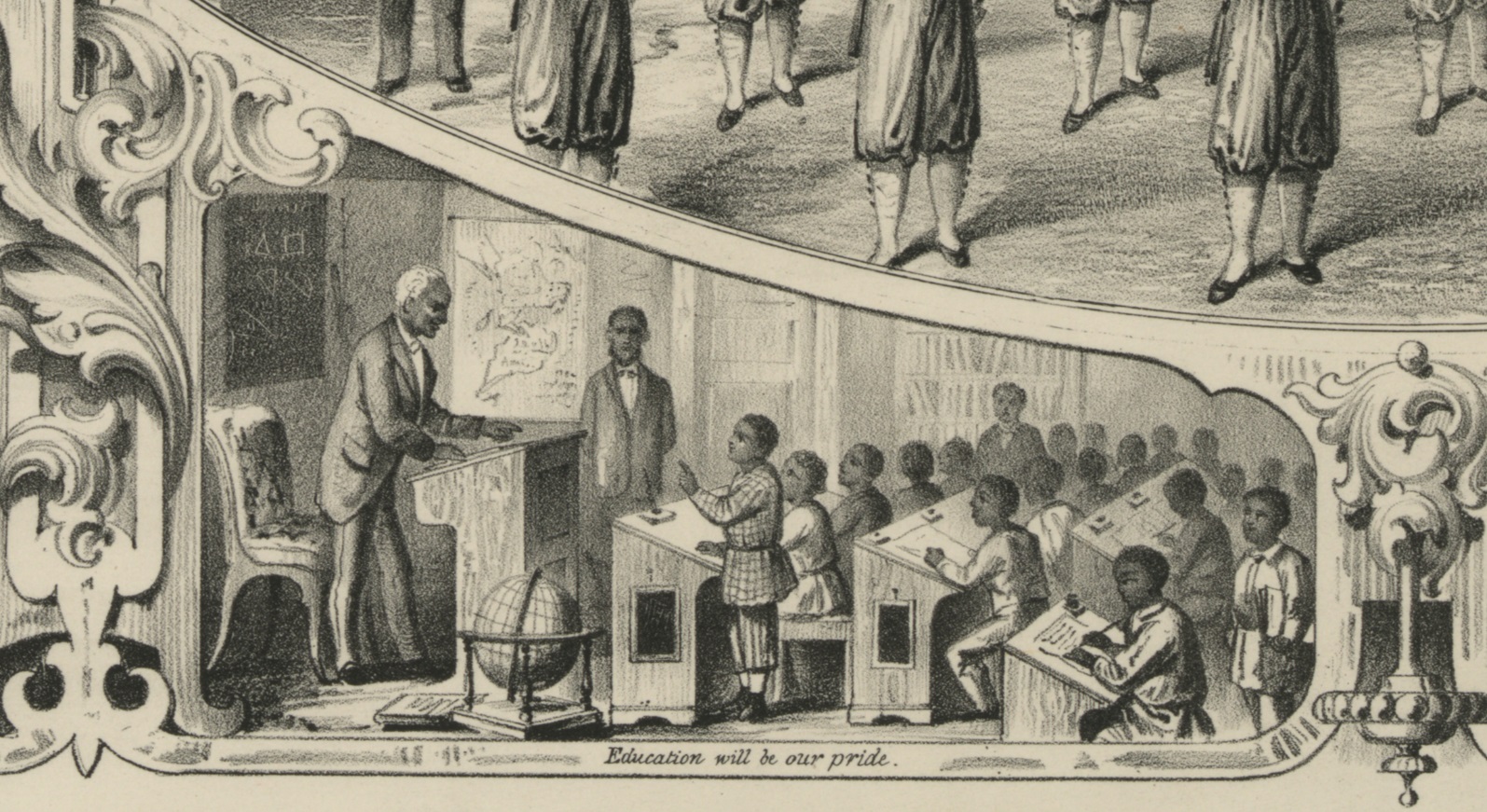
Detail from the lithograph, “The Result of the 15th Amendment and the rise and progress of the African race in America and its final accomplishment, and celebration on May 19th A.D. 1870,” Library of Congress Prints and Photographs Division Washington, D.C. 20540
Early History (1864-1867)
The early history of Colored School No.1 (Male and Female) begins with the Baltimore Association for the Moral and Intellectual Improvement of the Negro. What would become Colored School No. 1 was the largest school operated by the Association from 1864 to 1867, the period that they were responsible for the operation of the schools for colored children in Baltimore. When they turned over the schools under their control to the Board of School Commissioners in 1867, that school disbanded. It was centrally located in a building on Calvert and Saratoga streets.
The Baltimore Association oversaw operations of the colored schools in Baltimore for two school years, from 1864-1866. In their third year of operation they transferred the schools they supervised to the city’s Board of School Commissioners. When the city took responsibility of the colored schools, Colored School No. 1 (Male and Female) were housed in the Douglass Institute located on Lexington Street. Douglass Institute was an independent African American institution that was used for civic and political events in the African American community. In the first year of the city’s operation of the colored schools Colored School No.1 (male and female) had the largest number of students, 200 according to the 39th Report of the Board of School Commissioners.
The Fight for Expanded Education (1869-1889)
All of the schools established for African American students were primary schools. There were no grammar or high schools. In 1869 the Board of School Commissioners approved a resolution to allow the primary schools to add grammar grades to the primary schools. In the first year the colored schools were in operation the superintendent had requested the school board to open two grammar schools. One of the major initiatives of the African American community was to expand the curriculum for their children to the high school level, a fight that would take 16 years to win. However, by 1877 Baltimore’s African American community had gained a grammar school. It was located at 61 Saratoga Street.
Colored Schools No. 1, Male and Female remained at the Douglass Institute from 1867 until 1879 when the male and female divisions were split. Female Colored School No. 1 was moved to 61 Saratoga Street, the location of Colored Grammar School No. 1. Male Colored School No. 1 and Colored Grammar School No. 1 were moved to the “Old City Hall,” The Peale building, on Holliday Street (locations found in the Baltimore City Public School Directories – see uploaded images). In 1882 the African American community’s demands for a high school were met when the city council authorized the establishment of a colored high school. In 1883, the Board of School Commissioners followed the same model they used in establishing grammar schools. Instead of opening a new, separate high school, they simply added two grades to Grammar Colored School No. 1, located in the Peale Building. While the African American community now had a high school, the school had a limited curriculum. Only two grades were added to the grammar school and it did not confer “testimonials” on those who completed the curriculum. In order to receive testimonials students had to complete 4 years of high school. Testimonials were significant because they authorized recipients to teach in the primary and grammar schools.
The High and Grammar Colored School remained at the Holiday Street location until they were moved to Saratoga Street in 1889. Male Colored School No. 1 remained at the Holiday Street location until 1891 when it was moved to the Saratoga Street location as well. Throughout the later part of the 19th century African American Baltimoreans sought to gain full access to the educational opportunities the city offered to its white citizens. They often found their children with inadequate books, supplies, materials and facilities. When the city council authorized funds for the construction of a colored high school it was a major victory in their quest to achieve their educational goals. The facilities in the “old city hall” were inadequate, at best, for the proper instruction of the students there. Complaints of the teachers and the need for additional space by the water department further led to the eventual departure of Male Colored School No. 1 in 1891 ending the use of the Peale building as a colored school.
The Legacy of the Peale Building and African-American Education
What can be said about the Peale building’s role in the education of Baltimore’s African American community? For one, it is a symbol of progress towards the African American community’s struggle to gain full access to the city’s public schools. Serving as the location for the first colored high school in the city, a major victory and milestone for Baltimore’s African American community. As such, it represents a significant step towards gaining access to the benefits of full citizenship – education. The city’s earliest African American educators elected to teaching positions in the city’s colored schools attended school there. Within a year of opening the new colored high school, the city council passed an ordinance authorizing the Board of School Commissioners to allow graduates to teach in the colored schools. This too, was a major milestone and victory for Baltimore’s African American community. One of the major goals of the African American community was a campaign of “colored teachers for the colored schools.” The granting of testimonials to graduates of the Colored High School that attended when it was located in the Peale building is another way in which the location was significant. The Peale’s role cannot be viewed in isolation. It was part of the larger story of African American Baltimorean’s ongoing quest to gain full access to the city’s public schools and citizenship rights.
Submitted by Dr. Brian C. Morrison