 Sunday, October 7th, 2-4pm at the Peale
Free, RSVP
Meet the authors and get a signed book!
Buy your copy here or purchase one at the event.
ADVANCE PRAISE FOR From Blackface to Black Twitter
“In this important addition to the literature concerning black humor, Jannette L. Dates and Mia Moody Ramirez provide a wide-ranging and comprehensive overview of comedy by, for, and about African Americans. For newcomers to the field, the appendices will be a welcome guide, as will the historical scope offered by this volume. The major contribution of this book is in the authors’ very timely and important explication of the impact of new social media platforms on the deployment of black humor in the early 21st century, by both professional comedians and by the general public.”–Henry Louis Gates, Jr., Alphonse Fletcher University Professor and Director of Hutchins Center for African and African American Research, Harvard University
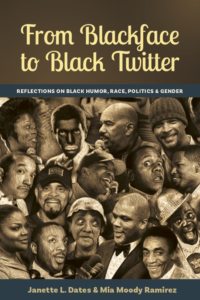
The new publication, From Blackface to Black Twitter: Reflections on Black Humor, Race, Politics and Gender (Peter Lang Publishing) by Jannette L. Dates (Baltimorean) and Mia Moody Ramirez traces the roots and fruits of comedy in the United States. The authors analyze and offer insights into the intersections of race, gender and politics in the humor developed by, for and, or about black people. The book’s ten chapters focus on how black and African American comedians of various periods used their communication skills and styles to reach professional and personal goals. As the authors examine the ways in which race-related stereotypes and cultural narratives are injected into humor by, for and about black people, they also analyze some of the obstacles black comedians faced and still face.
The book explores the ways in which African American humor reflects larger societal issues — for, many times black humor was not designed to just make audiences laugh, but to also make them think differently about issues. The book focuses on common threads frequently found among black comedians across time, generations, genders and types of humor, as the book pointedly addresses the uses of humor during pivotal moments in American history.
The authors argue specific points: that jesters, tricksters, humorists and comics have always been an integral part of African and then of African American life; that despite their bleak circumstances, America’s enslaved people and then its African American citizens who were dominated by Jim Crow laws and actions, used humor as a means of teaching, framing, shaming, lecturing, child-rearing, ridiculing, tricking, maneuvering, manipulating and/or promoting various viewpoints; that, in fact, to keep from crying in despair, pain or anger, African Americans often used humor to more freely express ideas that were not allowed to take root or bear fruit in most other venues; that sometimes black people used humor to skillfully control or manipulate what most often was an otherwise hostile environment, as they slyly used rhetorical devices to achieve psychological satisfaction while avoiding direct confrontation. These devices allowed black humorists to express ideas and opinions with encoded messages as they indirectly established their own views or sometimes their sense of dominance within what seemed to be innocuous verbal exchanges.
Most often, over the years each of the black humorists described in the book used their talents and skills to help move society to more readily embrace their people. That was the implicit or explicit goal of many of their comic acts and part of the embedded messages they delivered to black and to mixed audiences. The book’s authors argue that black comedians, as skilled communicators, used humor to help “move the needle” toward greater acceptance and inclusion of differences between and among black people by their own people and by the larger society.
About the authors
Jannette L. Dates
Dr. Jannette L. Dates is Dean Emerita of the Howard University School of Communications, where she served as the Dean for more than 18 years, Associate Dean for five years and as a full professor in the Department of Radio, Television and Film for many years. In 2013, Dr. Dates was appointed by President Obama to serve as a member of the Board of Directors of the Corporation for Public Broadcasting. In addition to From Blackface to Black Twitter, she co-edited two books: The Obamas and Mass Media: Race, Gender, Religion & Politics with Mia Moody-Ramirez and Split Image: African Americans in the Mass Media with Bill Barlow.
Dr. Dates served as president of the Broadcast Education Association, as president of the Association for Education in Journalism and Mass Communication, and as vice chair of the Accrediting Committee of the Accrediting Council on Education in Journalism and Mass Communication. She has appeared on “Booknotes with Brian Lamb” on CSPAN, “All Things Considered” on NPR, and “Our Visions” on BET among others. She is married to Victor H. Dates, Sr., a retired educator. They are the proud parents of four adult children ( an educator, a business executive, a lawyer and a doctor) and they have four grandchildren.
Mia Moody-Ramirez
Mia Moody-Ramirez, Ph.D., is a professor of journalism, public relations and new media at Baylor University. She has conducted research in the areas of portrayal of minority women in the media, reality television, racial stereotyping of women in rap music, the pros and cons of using social media in political campaign, and the continuing stereotyping of a small East Texas town more than a decade after a hate crime there in which a black man was dragged to his death behind a pickup truck.
Moody-Ramirez was the recipient of the 2018 Barrow Award, and the Outstanding Woman in Journalism award, given for excellence and high standards by the Association for Education in Journalism and Mass Communication, a nonprofit, educational association of journalism and mass communication educators, students and media professionals.
Moody-Ramirez is a former editor of the Missionary Baptist General Convention of Texas’ Women’s Ministry Magazine editor, a former staff writer and columnist for the Waco Tribune-Herald and a former editor and publisher of Elegant Woman magazine. She is the author of Black And Mainstream Press’ Framing Of Racial Profiling: A Historical Perspective.
Moody-Ramirez earned her Ph.D. in journalism from the University of Texas in 2006; a M.A. in journalism from Baylor University in 2001; a MS.Ed. in educational psychology from Baylor University in 1998; and a B.A. in Journalism from Texas A&M University in 1990.
She is married to Augustine Ramirez. They are the proud parents of Heidi, Timothy and Bill.