Puppets, Masks, and Crankies: Shifting the Story, $7,000- Sheila Gaskins, Tara Cariaso, and Maura Dwyer
PalatePALETTE, $7,000- Krystal C. Mack, Matt Freire, Sharea Harris, Émile Joseph Weeks, and Erin Nutsugah
Community Weaving Studio, $7,000- Ọmọlará Williams McCallister and Najee Haynes Follins
Funktopia Nation, $6,000- Petula Caesar, Jonathan Gilmore, Stevanie Williams, Jermeka Warren, Ben Pierce, Myles Gilmore, Phil Thomas, Mary Ellen Mink, Stephanie Edwards aka “Safiyatou.” Tamika Peters, and Chris Ashworth
What The Water Gave Me/Things My Mother Taught Me, $5,000- Alexis Araminta Renee, Kirby Griffin, Nia Hampton, and Alexis Renee
Latin(X)equis | Baltimore, $5,000- Hoesy Corona and Stephanie Mercedes
TERRA: LAND + BODY COLLECTIVE, $5,000- Jonna McKone, Se Jong Cho, and Elena DeBold
HellBond: Dancing with the Spirits, $5,000- Jia Le Ling and Michael Young
Stay tuned for in depth descriptions of the projects and how you can engage with all that they have to offer over the next year.
Grit Fund supports projects that add to the vibrancy and development of Baltimore’s arts and culture. We focus on funding projects that bring artists and community members together to explore a sense of place and shared space. We are searching for jurors to be part of our team that reviews the grant applications and decides who will be our Grit Fund 2022 Project Grant Recipients.
The deadline for applying to be a juror is February 14th, 2022, 11:59 pm EST.
Peale Awarded Grant to Help Gather Stories about Vaccination and Increase Vaccine Awareness
Last week, a coalition of national museum and library associations announced the recipients of the second round of funding for Communities for Immunity, and the Peale was among the awardees.
Supported by the Centers for Disease Control and Prevention (CDC) and the Institute of Museum and Library Services (IMLS), Communities for Immunity provides funding awards and support to museums and libraries engaging their communities to boost COVID-19 vaccine confidence. As trusted community partners, museums and libraries play a critical role in building vaccine confidence and fighting the pandemic.
“Through this unprecedented partnership, Communities for Immunity is providing nearly 100 museums, libraries, and tribal organizations across the country with over $1.6 million over two rounds of funding to help their community members make well-informed decisions about COVID-19 and vaccinations,” said Laura Lott, President and CEO of the American Alliance of Museums. “These organizations are linchpins in helping bring an end to the pandemic and leading their communities into a brighter, healthier future.”
We will be working with a host of community partners to do our part! Stay tuned!
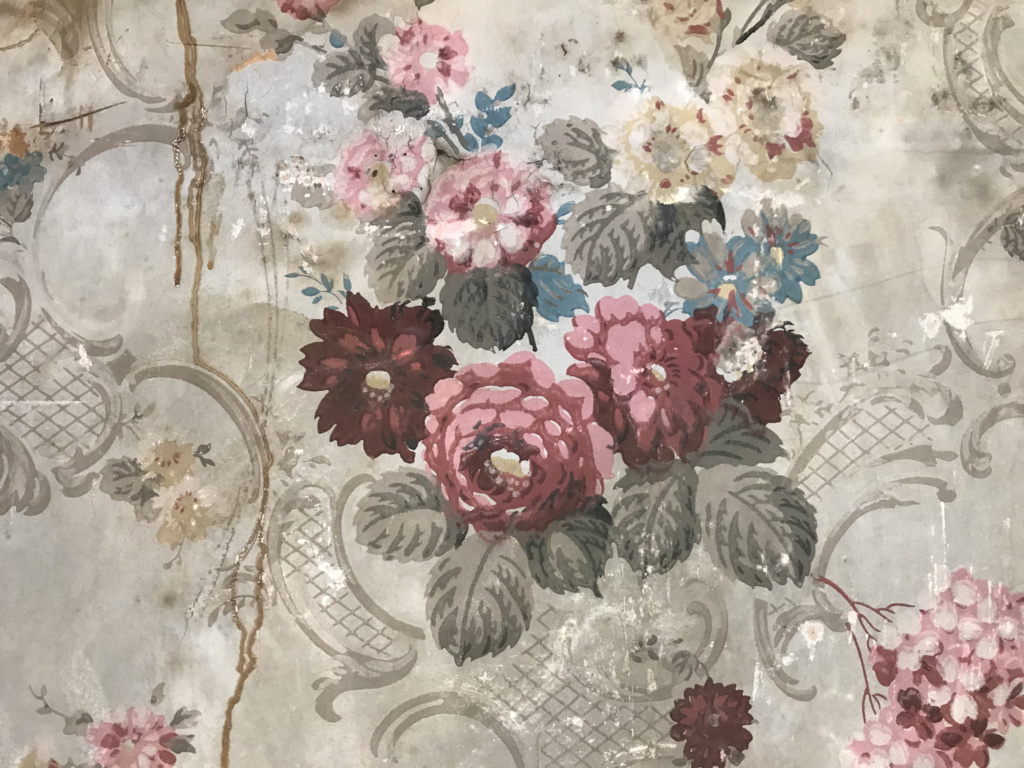
Close-up view of wallpaper pattern discovered behind a plaster wall at the Peale in the 2021 renovation.
In the past two hundred years, there has scarcely been an element that has had a more decisive impact on an interior than wallpaper. The color, texture, and patterning of paper hangings often determined the character of an interior space. Beyond that, from the 18th century on, the presence of wallpaper—once an expensive commodity—coincided with the rise of the middle class and its emerging ability to purchase luxury items. In essence, the rise in the popularity and affordability of wallpaper is like the burgeoning market for the automobile or the television, both items that were beyond the purchasing power of ordinary people. And, when the masses had cars and televisions, something shifted in the collective idea of what it meant to be “successful.” Such is the story of wallpaper as well. (Read a brief history of wallpaper from the V & A Museum.)
In the investigation of a historic site, it’s just as crucial to study wallpaper as it is to analyze woodwork, plaster, and paint. Yet, the serious study of wallpaper can be overlooked. In our own era, wallpaper is either loved or hated–mostly the latter, and often correlated with feminine decorative arts, jokingly associated with “your grandmother’s house.” Indeed, traditional, local museum collections don’t often contain everyday wallpapers, the way they might showcase silver, furniture, or paintings. On the other hand, design museums like the Cooper Hewitt in New York and the V & A in London have preserved thousands of examples of papers–like velvety flocked paper hangings and huge scenic wallpapers that once covered entire rooms with epic scenes of historical ruins. In their day, these were truly expensive works of art, printed by hand and reserved for the wealthy owners of colonial plantations like Prestwould in Virginia.
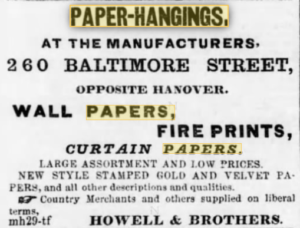
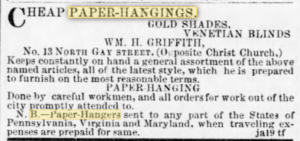
But no less impressive are the papers that made their way into more modest Baltimore homes and businesses. As early as 1798, Thomas and Caldeleugh advertised in the Federal Gazette and Baltimore Daily Advertiser, “An assortment of elegant French Paper Hangings of a superior quality, comprising a great variety of new and tasty figures.” (See citation 1)
From this point forward, especially with improvements in the technology after 1840 that enabled machine printing, there were never a lack of promotions for paper hangers and their wares. In the U.K., “production rose from around one million rolls in 1834 to nearly nine million rolls in 1860, while prices dropped to as little as a farthing a yard (0.25p).” (See citation 2)
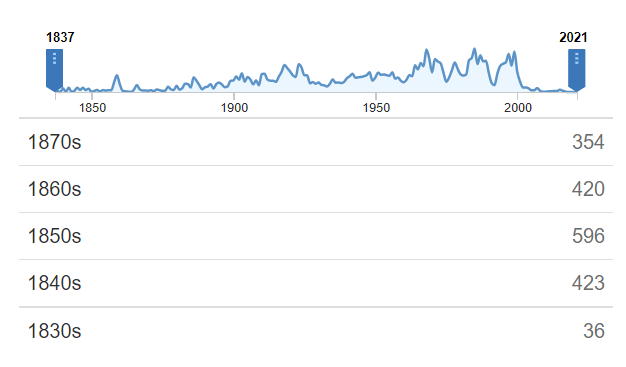
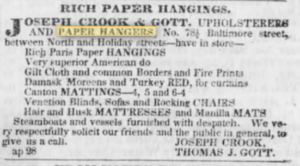
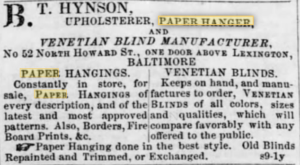
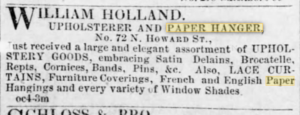
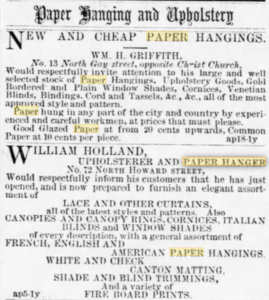
One search of Baltimore papers from Newspapers.com during the 19th century revealed a startling number of advertisements and mentions of paper hangers, again mirroring the changes in technology after 1840.
A graph showing the number of ads featuring the words, paper hanger, in three 19th-century Baltimore newspapers.
7 April 1840, The Baltimore Exchange
30 April 1840, The Pilot and Transcript
9 October 1858, The Baltimore Exchange
19 October 1858, The Baltimore Exchange
23 May 1859, The Baltimore Exchange
13 March 1860, The Baltimore Exchange
Without the name of a specific manufacturer or receipts that confirm the purchases of paper rolls, it’s difficult to date the paper that we discovered on the wall at the Peale this summer, but based on style, pattern, and similar samples in extant collections, the paper may date to the mid-to-late 19th century. At that time, the Peale was Baltimore’s City Hall (1830-1875). WHY would City Hall have such ornate wallpaper? This is an anachronistic question in some ways, born out of our modern tastes and belief system that public buildings should exude a certain strength and sobriety. However, exuberant, floral wallpapers were so popular at that time, they could have easily been included in public spaces like this one, not only was it attractive, but it also covered up unsightly cracks and kept out drafts–beautiful and practical! Even better, an advertisement in the Pennsylvania Packet from Joseph Dickinson (April 2, 1786) read:
It is found, by experience, that papering of rooms, both walls and ceilings, as well as entries, with this cheap paper, is far less costly, and much handsomer, than white washing.
Jumping forward into the 20th century, patterns and samples that are similar to ours DO appear in the Cooper-Hewitt museum’s collection that date to the 1940s, a time period when our building had already become the Peale Museum. The Peale was renovated in 1930 by the architect John H. Scarff, and his interpretation was purely Colonial Revival, meaning the renovation focused on recreating an impression of idealized colonial life–architecture, design, etc. Therefore, the use of this paper seems unlikely to have been installed at that time.
But, alas, there’s more work to be done here! When the building reopens in 2022, you’ll have a chance to see the wallpaper in person and share your insights with us! Stay tuned!
—Heather Shelton, Digital Curator and Registrar, The Peale
References:
Lynn, Catherine. “Wallpaper in America: From the Seventeenth Century to World War I,” New York: W.W. Norton & Company, 1980., pg 93.
A Brief History of Wallpaper, Victoria & Albert Museum: https://www.vam.ac.uk/articles/a-brief-history-of-wallpaper
The deadline for applications is October 12, 2021, at midnight EDT.
The Peale is thrilled to announce that it will release Emergency Recovery Grants (ERG) for Baltimore City and Baltimore County-based artists, through Grit Fund. With the support of the Andy Warhol Foundation for the Visual Arts and as a part of the Regional Regranting Program, Grit Fund-ERG will provide $500 mini-grants to Baltimore City and Baltimore County-based artists whose income and opportunities have been negatively impacted by the COVID-19 crisis. The ERG Fund totals $60,000 and will provide 120 grants to artists.
Since 2015, Baltimore’s artists have found support for their projects through Grit Fund. Ranging from out-of-school time programs that connect our youth to STEAM opportunities, and art-meets-journalism projects that communicate hidden stories of Black Baltimore, to community festivals that recapture and remind us of the strength of our city’s diversity, Grit Fund has been a dynamic, accessible, and much needed funding source in Baltimore City. Ever responsive to the community it serves, Grit Fund pivoted in 2020 to offering need-based support to artists.
Emergency Recover Grants will be available starting September 14, 2021. We anticipate a large number of applications will be submitted. Grit Fund-ERG will close when all funds are exhausted.
The deadline for applications is October 12, 2021, at midnight EDT.
Key Facts and Dates
Grit Fund will disperse $60,000 in emergency funding
Applications are open September 14 – October 12, 2021
Application deadline is October 12, 2021, at midnight EDT
Applications will be reviewed as a batch
These unrestricted $500 mini – grants may be used for Baltimore City and Baltimore County based artists’ immediate needs such as housing, utilities, food, childcare, healthcare, etc.
About the Andy Warhol Foundation
The Andy Warhol Foundation for the Visual Arts Regional Regranting Program aims to support vibrant, under-the-radar artistic activity by partnering with leading cultural institutions in communities across the country. The program allows the Foundation to support informal, non-incorporated artist collectives and to support their alternative gathering spaces, publications, websites, events and other projects. For more information about the Andy Warhol Foundation visit its website.
About the Peale
The Peale is a 501(c)(3) tax-exempt, non-profit corporation established to restore the historic Peale Museum building as a center to celebrate the unique history of Baltimore, its people, and places. By creating a more inclusive cultural record of the city, the Peale aims to help people everywhere see Baltimore in a new light. For more about the Peale, visit its website.
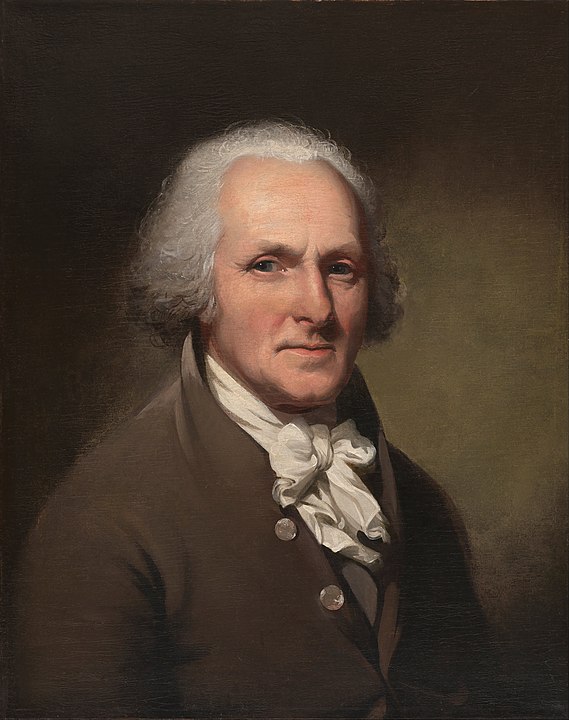
Self-portrait of Peale (c. 1791) at the National Portrait Gallery in Washington, D.C. Public Domain
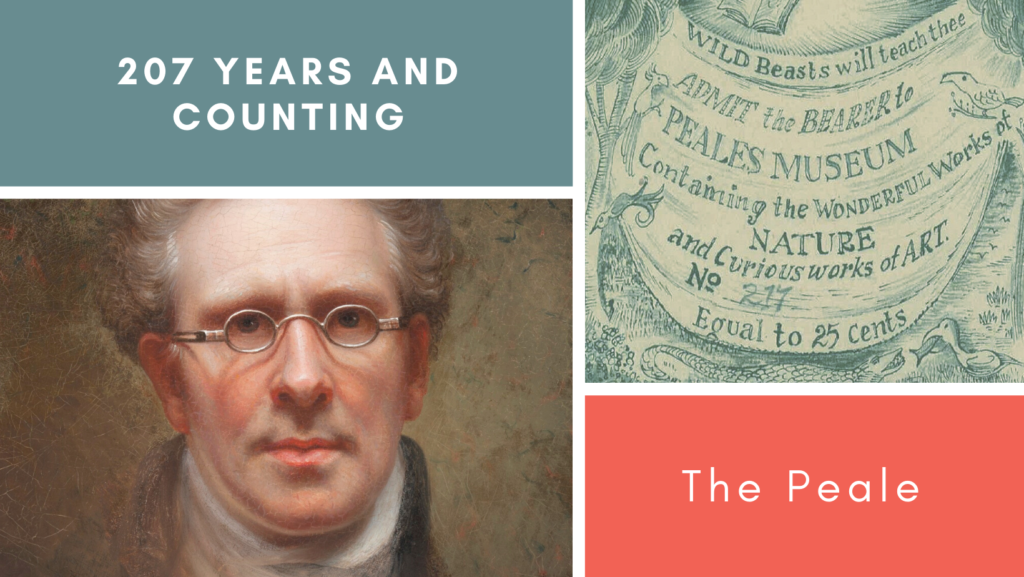
This summer, as the Peale Museum building approaches its 207th birthday, we’re featuring quotes, excerpts from letters, advertisements, and Peale trivia that shed light on Rembrandt Peale and his original museum. Check out an excerpt from a letter sent by Charles Willson Peale to his son Rembrandt. The missive is dated October 1814, roughly one month after the Battle of Baltimore, defending the city from the British in the War of 1812.
Belfield Octr.16.1814 Dear Rembrandt,
“After a storm comes a calm,” you have weathered a hard storm of apprehension of danger, and the Citizens of Baltimore have done themselves immortal honor by their exertions to defend the City against the stuped British. I call them stupid because it is the height of stupidity for them to wage war against the Americans, whose friendship they ought in good policy to cultivate. so much for politiks [sic]*. I hope you now doing your best at Portraits, and, making pleasing pictures is the only way to obtain full imployment [sic], and it is the most profitable labour you can put your hands too. . . .
It is natural enough for the british to make high demands when they had determined to send a large Army against America, and it would be easy for them to lower their demands afterwards, What have they done? Burned washington [sic]. What did it cost them in men & expence? More than they chuse [sic] to acknowledge. No doubt the burning of Washington will make them exult and perhaps London will be illuminated on the occassion [sic].
But what will they think when they know how they were foiled at Baltemore [sic] . . . Their foolish proclamation of burning all our assaillable [sic] towns & other conduct, such as plundering Citizens, will do them much injury, by uniting America & joining them heartily in a vigorous defense. . . . it is my real belief that we shall shortly have peace, however contrary to the present appearance. . . . Rubens will be going presently therefore I must end my epistle. Give our love to the family, write to me when you find leisure.
Yrs. CWPeale
*What does [sic] mean? When used in brackets, the notation means that the preceding word appears exactly as written in the original, even if seems odd or is misspelled.
Peale Museum Advertisement, Federal Gazette and Baltimore Daily Advertiser
BALTIMORE. NOVEMBER 29, 1814*
Evening Illumination
of Peale’s Museum, and
GALLERY OF THE FINE ARTS.
TUESDAYS & THURSDAYS
In announcing to the public the commencement of the Evening Illuminations on the plan adopted in Philadelphia, the proprietor deems it proper to remark that in making no addition to the price of admission, notwithstanding the encreased expense, his renumination must depend on the numbers whose leisure and curiousity may thus be gratified. The same moderate stationary charge will prevent mistakes and facilitate the arrangement of parties.A Music Gallery having been constructed where it is intended to place an organ to be built for the purpose, the proprietor in the meanwhile, has procured for use of Ladies and Gentlemen acquainted with music, an excellent Six Octave Piano made by Mr. Stewart of this city.
Subscribers are requested to take notice that the privileges of the Annual Tickets do not extend to the Evening Exhibitions.
The Skeleton of the MAMMOTH, discovered in the State of N. York in 1801, and exhibited in this city 11 years ago, forms an interesting part of the Museum; and besides the Birds, Beasts, Fishes, Snakes, Shells, Antiquities, Indian Dresses, War Instruments and Miscellaneous Curiosities, its principle peculiarity is the
SALOON OF PAINTINGS
Admittance to the whole 25 cents.
*The same ad was repeated on November 29, December 6, and December 8, 1814.
Miller, Lillian B., ed. “The Selected Papers of Charles Willson Peale and His Family,” vol. 3, The Belfield Farm Years, 1810-1820. New Haven and London: Yale University Press, 1991, pgs. 284-5.
Q. Where did the floors in the current Peale building originate?
The Peale building was extensively renovated in 1930-31 by John Henry Scarff, a World War I Army veteran who later became an architect with the firm Wyatt and Nolting in Baltimore. In 1931, Scarff was “invited by the Mayor and City Council of Baltimore to supervise renovations at the Rembrandt Peale Museum . . .. He planned the reorganization of the museum, selected a director, and outlined new museum policies.”*
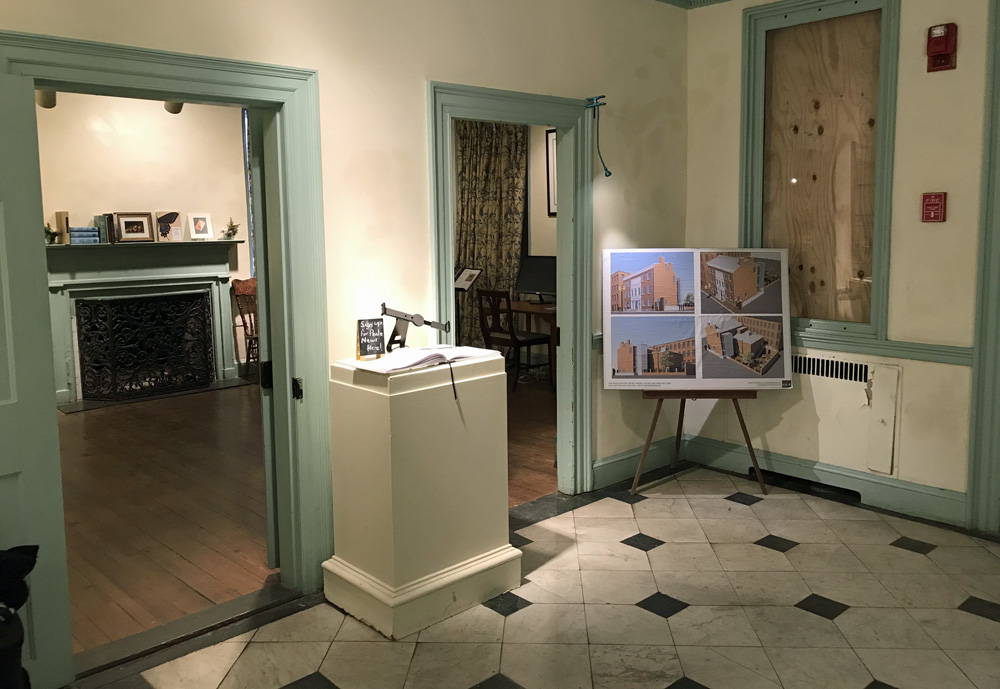
A 1991 historic structures report revealed that, “New flooring materials were installed throughout in the restoration of 1930-31. Marble floors in the Loggia, the Entrance Hall, first story Hyphen and hearths came from the original building of the Enoch Pratt Free Library on Mulberry Street. Pine floors for the Northwest, Southwest, and Southeast rooms of the first floor came from dwellings being demolished at the southwest corner of St. Paul and Saratoga Streets. The white oak flooring elsewhere, throughout the building, was new, a materials of excellent quality, mostly quarter-sawn in wide, random widths. Original flooring may remain beneath much of the wood flooring although none is visible except at the landings and floor level stairs, between the newels.”
*With his military experience, Scarff was called to service again in World War II, this time as the Special Assistant to Huntington Cairns, the Secretary-Treasurer of the American Commission for the Protection and Salvage of Artistic and Historic Monuments in War Areas (the so-called “Monuments Men”). With this, Scarff began “creating policies regarding looted art, forced transfers, damaged monuments, and restitution procedures for displaced collections.” Source: Monuments Men Foundation for the Preservation of Art: Restitution, Education, Preservation, website, https://www.monumentsmenfoundation.org/scarff-john-h.
Rembrandt Peale to Thomas Jefferson Philadelphia, July 13, 1813
Dear Sir
In a Box of Books which general Armstrong presented to the Pennsylvania Academy of Fine-Arts there were packed up several articles belonging to himself which he requested me to take charge of, It was a long time after I had them before I remarked a small package for you, containing 3 Stones which you were desirous of possessing, accompanied with a letter from the gentleman who purchased them for you. The small piece which he mentions having cemented, I found again loose—but no other damage. Dr marks & afterwards a near neighbour of yours promised to take charge of them but they failed giving me notice of their departure, and I now remit them by Mr Correa for whom they have been long waiting.
Having purchased the museum in Baltimore, I mean to form a handsome establishment in that City, the general plan of which will differ from my fathers museum, it being my intention to render it more properly a museum of Arts & Sciences, and, without neglecting any branch of Natural History to bestow my chief attention to the formation of a Picture Gallery & Depository of the course and products of Manufactures.
I still hope some fortunate leisure will enable me to pay a Visit to Monticello. In the meanwhile believe me Sir
Your friend.
respectfully,
Rembrandt Peale
Thomas Jefferson to Rembrandt Peale Monticello, VA, August 11, 1813
Dear Sir
I duly recieved by mr Correa your favor of July 13 and with it the peices of agate & Madrepore sent me thro’ Genl Armstrong & to your care. the transaction stated in the letter accompanying them had so entirely escaped my memory, that the name being subscribed in illegible characters, I am not able to ascertain from whom it comes. I am not however the less obliged to one who recollects to do a kind office when I had forgotten the having requested it. I sincerely wish you success in the establishment of your museum. these things kindle a thirst for knolege, and often draw to useful objects those who would otherwise employ themselves frivolously. should any circumstance ever lead you within striking distance of Monticello I should be very happy to recieve you. Accept the assurance of my great esteem & respect.