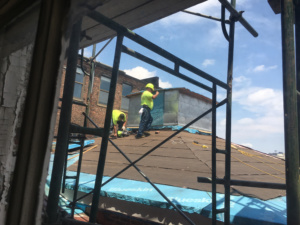
Baltimore City’s Department of General Services is in the final stages of replacing the Peale’s roof and restoring the exterior masonry. Renovation has now begun on the cupola that gives natural light to the “picture gallery.” It was the addition of this gallery to the Federal-style row house that made Rembrandt Peale’s 1814 museum an architectural innovation by Robert Cary Long, Sr.
The replacement of the Peale’s roof and restoration of its exterior is being undertaken by Baltimore City’s Department of General Services.
Completion of the renovation work is planned by end of Summer 2017. The Peale is open for special events and available for rental throughout the renovation of the building’s exteriors. Contact us if you have questions or would like to visit!
Does your child love music? film? stories? Hip Hop culture?
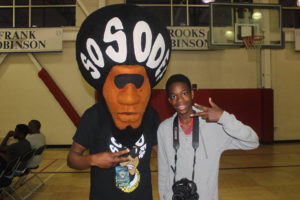
The Media Rhythm Institute is offering 6 week Hip Hop songwriting and documentary-making courses at the Peale, Mon-Thu 6-8pm from July 10 – August 18, 2017. Kids aged 8-18 are welcome at the discounted summer rate of $360 per student, per course; $670 for both courses.
Register for Songwriting: Mon & Wed; Documentary-making: Tue & Thu
WBAL’s Barry Simms visited Lakeland Elementary/Middle School today to check out the Reading Literacy Program from iRhyme that will be at the Peale this summer from July 10-August 18. Sample the MRI kids’ creativity and great stories here!
The Media Rhythm Institute (MRI) is running a six week Hip Hop songwriting and documentary-making courses for kids aged 8-18, July 10 –August 18, 2017 at The Peale Center for Baltimore History and Architecture. The first museum ever built in the US, the storied Peale will host the newest kinds of multimedia storytelling about the places and people of Baltimore thanks to courses taught by iRhyme and Channel Me Media. The Media Rhythm Institute is a new partnership between Channel Me Media and iRhyme, which was recently featured on WBAL and WMAR: WBAL: http://www.wbaltv.com/article/video-students-anti violencevideos-call-for-change/10019386
WMAR: http://www.abc2news.com/news/region/baltimorecity/music-recording-program-teaches-literacy-in-baltimore?page=2
Gary Hawkins III, youth media specialist and Media Rhythm Institute participant.
Jimmie Thomas, Filmmaker and co-founder of the Media Rhythm Institute, said: “This program gives the youth an opportunity to guide and enhance their network, skills and voices by learning how to use music, multimedia, reading and more to control their own narrative.” “iRhyme and Channel Me Media have helped hundreds of kids across the city apply their creativity and develop their skills in communication and entrepreneurship,” said Nancy Proctor, director of the Peale Center for Baltimore History and Architecture. “We are honored that thanks to the Media Rhythm Institute partnership, the Peale can be a new platform for their great work.” The courses run Mon-Thu from 6-8pm at the Peale, across from the City’s Abel Wolman Municipal Building on Holliday Street and next door to the Real News Network and Zion Church. For kids whose families can’t afford the discounted summer rate of $360 per course, the MRI has launched a crowdfunding campaign on Indiegogo: https://igg.me/at/mediarhythminstitute
This six week summer program harnesses the ambitions of young people who want to be like the media heroes they follow, and engages that energy to help students comprehend texts, sharpen math and communication skills, and learn 21st century skills in media, technology, and creative entrepreneurship. At the end of the courses, students produce DVDs of their work they can sell, developing sales, marketing, and business management skills. The students will also perform and present their work in a live event at the Peale.
Nate Couser and Hullywood interviewed the Peale’s Director Nancy Proctor on The Artist Exchange Radio Show on July 7. From about 32 minutes in to the show, hear about the plans and vision for reinventing the urban museum at the Peale Center, the first museum ever purpose-built in the United States.
On May 17, the Peale’s new director, Nancy Proctor, spoke about her work with the Be Here: Baltimore cultural storytelling initiative and how it has transformed the vision for The Peale Center for Baltimore History and Architecture. Her presentation, hosted by Meet the Media Guru at Palazzo Litta in Milan, was recorded and is available online. (English starts around 25 min.)
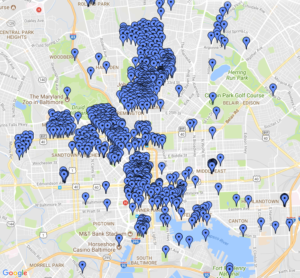
Listen to stories of Baltimore recorded for the Be Here project.
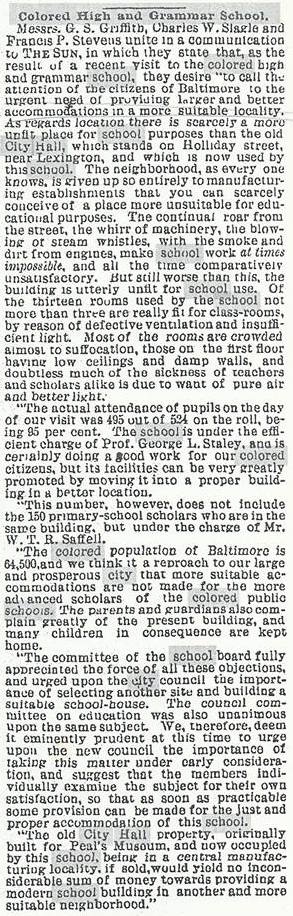
Baltimore Sun article on “The Colored School,” 1885.
In 1865, at the end of the Civil War, an organization called the Baltimore Association for the Moral and Social Improvement of the Colored People was formed. The association raised money and opened a number of free schools for black children. The city agreed to contribute $10,000 as well.
In 1867 the city council voted to operate schools for black children, replacing all black teachers with white ones, and with that the Baltimore Association turned its buildings over to the city. Some were closed, some were refurbished, and some were used in their existing condition. The Baltimore City Council opened 13 primary schools but no grammar or high schools were established for blacks because it was thought “neither advisable nor practical to provide grades or schools for this class of people.” (This generation made distinctions among grade schools and primary schools and high schools.)
In 1869 the city council opened publicly funded grammar schools for blacks and one was started at the Peale called Colored Grammar School Number One.
1878 “By a resolution of the City Council, the Inspector of Buildings was directed to alter and repair the old City Hall building on Holliday street, for the use of Colored Primary Schools No. 1, and these schools are now occupying their new apartments with better light and ventilation and more comfort than they have ever had since their organization.”
In 1882 a Colored High School with a two year program was housed with the Colored Grammar School in what the minutes say was “The old city hall at Holliday near Lexington.” After six years it moved to a new building on Saratoga and in 1889 its graduates (there were 18 in the first classes) were certified to teach.
In 1883 the Annual Reports of the Board of School Commissioners recorded, “The building occupied by the Colored High and Grammar School and Male Colored School No. 1 is not a suitable one in scarcely any respect. It is not well arranged and some of the rooms are too small and very badly lighted. In some of the rooms, on the lower floor, it is scarcely possible to see sufficiently well to read on cloudy days. If, in case of fire or for any other cause, it became necessary to move the children quickly out of the building, great difficulty would be experienced on account of the narrow stairway down which pupils on the third floor have to pass in getting out of the building.”
“In Baltimore at the end of the 19th century is one of the most intriguing periods of the building’s history, but so far little is known about this period. Here are a few notes we have from Peale Center board members Jean Baker and Jim Dilts; please add to our knowledge base if you can, and forward this request for information to anyone you know who might be able to help!” –Nancy Proctor, Peale Center Director
By 1884 things hadn’t improved: the stairway was still a hazard, and “This neighborhood is too noisy for the location of a school.”
Afterwards, the poor conditions persisted and in 1887, the School Commissioners reported that there was a “building in course of erection on Saratoga St. near St. Paul for the use of Colored High and Grammar School and Male and Female Colored School No. 1 [to] furnish these schools with ample accommodations.”
Can you help fill in the details of the history of public education for African Americans at the Peale? We’re keen to learn more about this pivotal chapter in Baltimore history, and look forward to hearing from you!
Articles by Bettye Collier Thomas in the Maryland Historical Magazine
Annual Reports of the Board of School Commisioners 1878-1887, notes by Jeff Korman, June 5, 2007
MA thesis at Howard University on the History of Public Education in the city of Baltimore by Vernon, Vavrina