Historic Wallpaper at the Peale Discovered

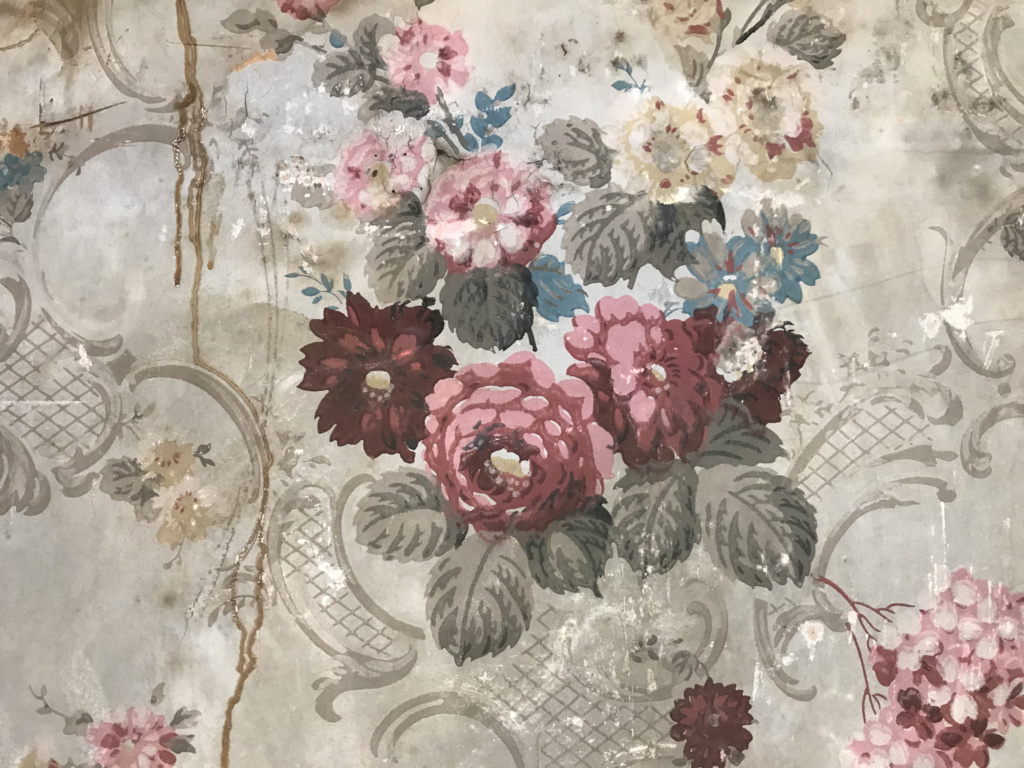
Historic wallpaper showing red and pink flowers and a cross-hatched basket pattern behind it.
Close-up view of wallpaper pattern discovered behind a plaster wall at the Peale in the 2021 renovation.

In the past two hundred years, there has scarcely been an element that has had a more decisive impact on an interior than wallpaper. The color, texture, and patterning of paper hangings often determined the character of an interior space. Beyond that, from the 18th century on, the presence of wallpaper—once an expensive commodity—coincided with the rise of the middle class and its emerging ability to purchase luxury items. In essence, the rise in the popularity and affordability of wallpaper is like the burgeoning market for the automobile or the television, both items that were beyond the purchasing power of ordinary people. And, when the masses had cars and televisions, something shifted in the collective idea of what it meant to be “successful.” Such is the story of wallpaper as well. (Read a brief history of wallpaper from the V & A Museum.)

In the investigation of a historic site, it’s just as crucial to study wallpaper as it is to analyze woodwork, plaster, and paint. Yet, the serious study of wallpaper can be overlooked. In our own era, wallpaper is either loved or hated–mostly the latter, and often correlated with feminine decorative arts, jokingly associated with “your grandmother’s house.” Indeed, traditional, local museum collections don’t often contain everyday wallpapers, the way they might showcase silver, furniture, or paintings. On the other hand, design museums like the Cooper Hewitt in New York and the V & A in London have preserved thousands of examples of papers–like velvety flocked paper hangings and huge scenic wallpapers that once covered entire rooms with epic scenes of historical ruins. In their day, these were truly expensive works of art, printed by hand and reserved for the wealthy owners of colonial plantations like Prestwould in Virginia.

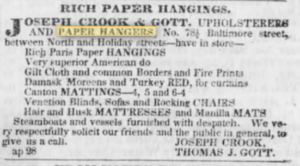
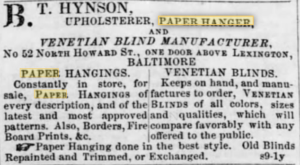
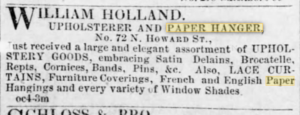
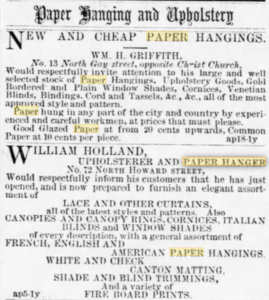
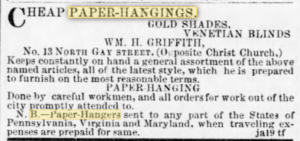
But no less impressive are the papers that made their way into more modest Baltimore homes and businesses. As early as 1798, Thomas and Caldeleugh advertised in the Federal Gazette and Baltimore Daily Advertiser, “An assortment of elegant French Paper Hangings of a superior quality, comprising a great variety of new and tasty figures.” (See citation 1)

From this point forward, especially with improvements in the technology after 1840 that enabled machine printing, there were never a lack of promotions for paper hangers and their wares. In the U.K., “production rose from around one million rolls in 1834 to nearly nine million rolls in 1860, while prices dropped to as little as a farthing a yard (0.25p).” (See citation 2)

One search of Baltimore papers from Newspapers.com during the 19th century revealed a startling number of advertisements and mentions of paper hangers, again mirroring the changes in technology after 1840.
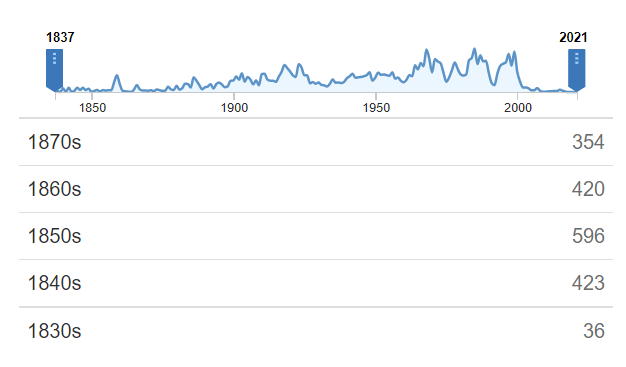
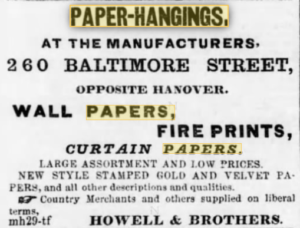
A graph showing the number of ads featuring the words, paper hanger, in three 19th-century Baltimore newspapers.

Without the name of a specific manufacturer or receipts that confirm the purchases of paper rolls, it’s difficult to date the paper that we discovered on the wall at the Peale this summer, but based on style, pattern, and similar samples in extant collections, the paper may date to the mid-to-late 19th century. At that time, the Peale was Baltimore’s City Hall (1830-1875). WHY would City Hall have such ornate wallpaper? This is an anachronistic question in some ways, born out of our modern tastes and belief system that public buildings should exude a certain strength and sobriety. However, exuberant, floral wallpapers were so popular at that time, they could have easily been included in public spaces like this one, not only was it attractive, but it also covered up unsightly cracks and kept out drafts–beautiful and practical! Even better, an advertisement in the Pennsylvania Packet from Joseph Dickinson (April 2, 1786) read:

It is found, by experience, that papering of rooms, both walls and ceilings, as well as entries, with this cheap paper, is far less costly, and much handsomer, than white washing.

Jumping forward into the 20th century, patterns and samples that are similar to ours DO appear in the Cooper-Hewitt museum’s collection that date to the 1940s, a time period when our building had already become the Peale Museum. The Peale was renovated in 1930 by the architect John H. Scarff, and his interpretation was purely Colonial Revival, meaning the renovation focused on recreating an impression of idealized colonial life–architecture, design, etc. Therefore, the use of this paper seems unlikely to have been installed at that time.

But, alas, there’s more work to be done here! When the building reopens in 2022, you’ll have a chance to see the wallpaper in person and share your insights with us! Stay tuned!

Heather Shelton, Digital Curator and Registrar, The Peale


References:

  1. Lynn, Catherine. “Wallpaper in America: From the Seventeenth Century to World War I,” New York: W.W. Norton & Company, 1980., pg 93.
  2. A Brief History of Wallpaper, Victoria & Albert Museum: https://www.vam.ac.uk/articles/a-brief-history-of-wallpaper

See other digital wallpaper collections: Historic New England, Victoria & Albert Museum, Metropolitan Museum of Art, Cooper-Hewitt Design Museum
Peale History: From Father to Son

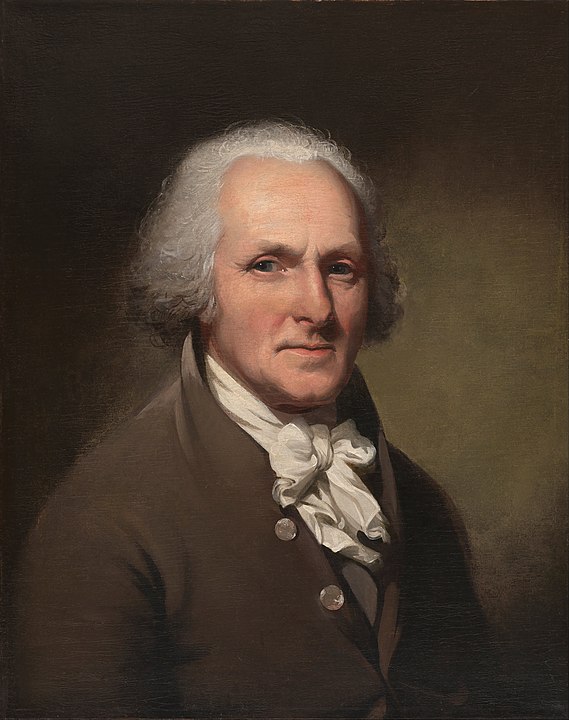
A portrait of Charles Willson Peale wearing a brown jacket and with a white wig or powdered hair.
Self-portrait of Peale (c. 1791) at the National Portrait Gallery in Washington, D.C. Public Domain

This summer, as the Peale Museum building approaches its 207th birthday, we’re featuring quotes, excerpts from letters, advertisements, and Peale trivia that shed light on Rembrandt Peale and his original museum. Check out an excerpt from a letter sent by Charles Willson Peale to his son Rembrandt. The missive is dated October 1814, roughly one month after the Battle of Baltimore, defending the city from the British in the War of 1812.

Belfield Octr.16.1814
Dear Rembrandt,


“After a storm comes a calm,” you have weathered a hard storm of apprehension of danger, and the Citizens of Baltimore have done themselves immortal honor by their exertions to defend the City against the stuped British. I call them stupid because it is the height of stupidity for them to wage war against the Americans, whose friendship they ought in good policy to cultivate. so much for politiks [sic]*. I hope you now doing your best at Portraits, and, making pleasing pictures is the only way to obtain full imployment [sic], and it is the most profitable labour you can put your hands too. . . .


It is natural enough for the british to make high demands when they had determined to send a large Army against America, and it would be easy for them to lower their demands afterwards, What have they done? Burned washington [sic]. What did it cost them in men & expence? More than they chuse [sic] to acknowledge. No doubt the burning of Washington will make them exult and perhaps London will be illuminated on the occassion [sic].


But what will they think when they know how they were foiled at Baltemore [sic] . . . Their foolish proclamation of burning all our assaillable [sic] towns & other conduct, such as plundering Citizens, will do them much injury, by uniting America & joining them heartily in a vigorous defense. . . . it is my real belief that we shall shortly have peace, however contrary to the present appearance.  . . .  Rubens will be going presently therefore I must end my epistle. Give our love to the family, write to me when you find leisure.


Yrs. CWPeale

*What does [sic] mean? When used in brackets, the notation means that the preceding word appears exactly as written in the original, even if seems odd or is misspelled.


Peale Trivia: Peale’s Gallery

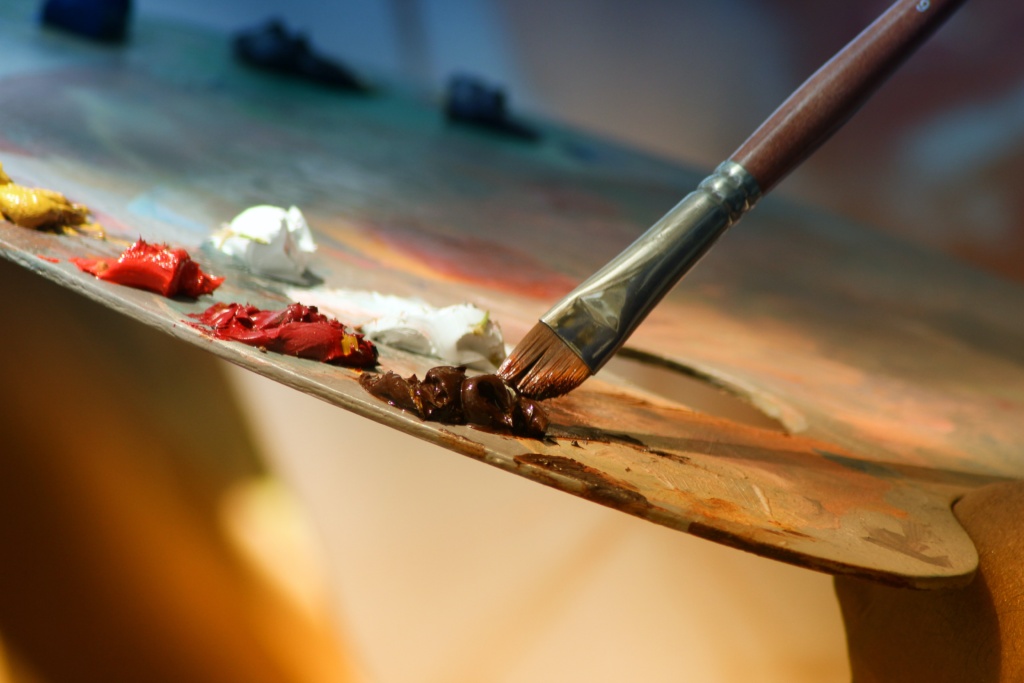
A close-up view of an artist's palette and a paint brush that it being dipped into a gob of dark brown paint.

Q. Which of these artist’s paintings did NOT appear in Rembrandt Peale’s early gallery?

A. According to early documentation, the artist who did NOT appear in the Peale’s museum was Vincent Van Gogh. The others were all represented.

An 1823 catalog lists the following artists whose works were on display: Leonardo da Vinci, Gainsborough, Breughel, Reynolds, Bosch, van de Velde, Ruysdael, Kauffman, Claude Lorrain, Poussin, Velasquez, Canaletto, Raphael, Sully. The exhibit also included works by Charles Willson Peale, then the foremost portrait painter in the country, and by members of his artistic extended family, Raphaelle, Rembrandt, and Sarah Miriam Peale. Baltimore collectors lent most of the paintings.

> Learn more about the history of the Peale building!

Peale Trivia: The Oldest American Artist

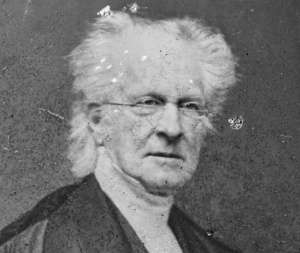
Rembrandt Peale in an early photograph has wispy white hair and a black jacket.

Q. Which American photographer captured this early image of Rembrandt Peale, the founder of the Peale Museum?

A. This photograph of Peale was taken in 1860, when he was 82 years old. Peale died on October 3 of that year, in Philadelphia. The man who captured his likeness was Mathew Brady (1822-1896). Brady opened a studio in New York in 1844, where notable figures like Abraham Lincoln, Walt Whitman, and P. T. Barnum were photographed. He is best known for his shocking images of the Civil War, capturing scenes of horror and distress the likes of which had never been seen by Americans. The prolific Brady took more than 10,000 photographs from that period.

According to the Smithsonian’s American Art Museum, Brady “directed a large staff of photographers from his Washington, DC headquarters, which necessitated his skills as a historian, perhaps his greatest contribution to the Civil War . . . Like most photographers during the war, Brady rarely photographed actual battles. Cumbersome camera equipment and slow exposure times made it difficult to capture action. Instead, they focused on the aftermath of the battle, military portraits, and scenes of camp life . . . His picture of a Northern soldier being aided by another played to the collective trauma of mid-nineteenth century American households, most of whom . . . had suffered the loss of a relative or friend.” Despite his incredible contributions to American art and history, Brady died penniless in 1896.

Photo: Public Domain, courtesy Wikipedia; the original can be found at United States Library of Congress, Prints and Photographs division under the digital ID cwpbh.02797

Peale Museum Advertisement

The heading of an early 19th-century newspaper that reads, Federal Gazette and Daily Baltimore Advertiser

Peale Museum Advertisement, Federal Gazette and Baltimore Daily Advertiser
BALTIMORE. NOVEMBER 29, 1814*

Evening Illumination
of Peale’s Museum, and
GALLERY OF THE FINE ARTS.
TUESDAYS & THURSDAYS


In announcing to the public the commencement of the Evening Illuminations on the plan adopted in Philadelphia, the proprietor deems it proper to remark that in making no addition to the price of admission, notwithstanding the encreased expense, his renumination must depend on the numbers whose leisure and curiousity may thus be gratified. The same moderate stationary charge will prevent mistakes and facilitate the arrangement of parties.A Music Gallery having been constructed where it is intended to place an organ to be built for the purpose, the proprietor in the meanwhile, has procured for use of Ladies and Gentlemen acquainted with music, an excellent Six Octave Piano made by Mr. Stewart of this city.


Subscribers are requested to take notice that the privileges of the Annual Tickets do not extend to the Evening Exhibitions.

The Skeleton of the MAMMOTH, discovered in the State of N. York in 1801, and exhibited in this city 11 years ago, forms an interesting part of the Museum; and besides the Birds, Beasts, Fishes, Snakes, Shells, Antiquities, Indian Dresses, War Instruments and Miscellaneous Curiosities, its principle peculiarity is the


SALOON OF PAINTINGS
Admittance to the whole 25 cents.

*The same ad was repeated on November 29, December 6, and December 8, 1814.

Miller, Lillian B., ed. “The Selected Papers of Charles Willson Peale and His Family,” vol. 3, The Belfield Farm Years, 1810-1820. New Haven and London: Yale University Press, 1991, pgs. 284-5.

Peale Trivia! Let’s Play

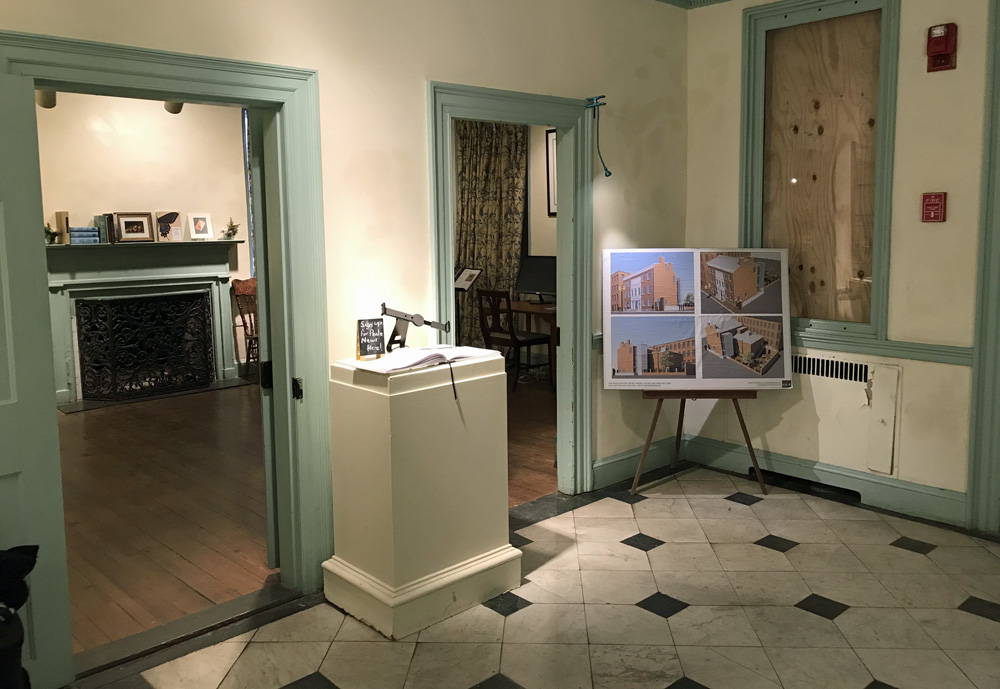
The interior foyer of the Peale building, showing a black and white tiled floor and two doorways.

Q. Where did the floors in the current Peale building originate?

The Peale building was extensively renovated in 1930-31 by John Henry Scarff, a World War I Army veteran who later became an architect with the firm Wyatt and Nolting in Baltimore. In 1931, Scarff was “invited by the Mayor and City Council of Baltimore to supervise renovations at the Rembrandt Peale Museum . . .. He planned the reorganization of the museum, selected a director, and outlined new museum policies.”*

A 1991 historic structures report revealed that, “New flooring materials were installed throughout in the restoration of 1930-31. Marble floors in the Loggia, the Entrance Hall, first story Hyphen and hearths came from the original building of the Enoch Pratt Free Library on Mulberry Street. Pine floors for the Northwest, Southwest, and Southeast rooms of the first floor came from dwellings being demolished at the southwest corner of St. Paul and Saratoga Streets. The white oak flooring elsewhere, throughout the building, was new, a materials of excellent quality, mostly quarter-sawn in wide, random widths. Original flooring may remain beneath much of the wood flooring although none is visible except at the landings and floor level stairs, between the newels.”

> Learn more about our unique building history.


*With his military experience, Scarff was called to service again in World War II, this time as the Special Assistant to Huntington Cairns, the Secretary-Treasurer of the American Commission for the Protection and Salvage of Artistic and Historic Monuments in War Areas (the so-called “Monuments Men”). With this, Scarff began “creating policies regarding looted art, forced transfers, damaged monuments, and restitution procedures for displaced collections.” Source: Monuments Men Foundation for the Preservation of Art: Restitution, Education, Preservation, website, https://www.monumentsmenfoundation.org/scarff-john-h.

Thomas Jefferson to Rembrandt Peale

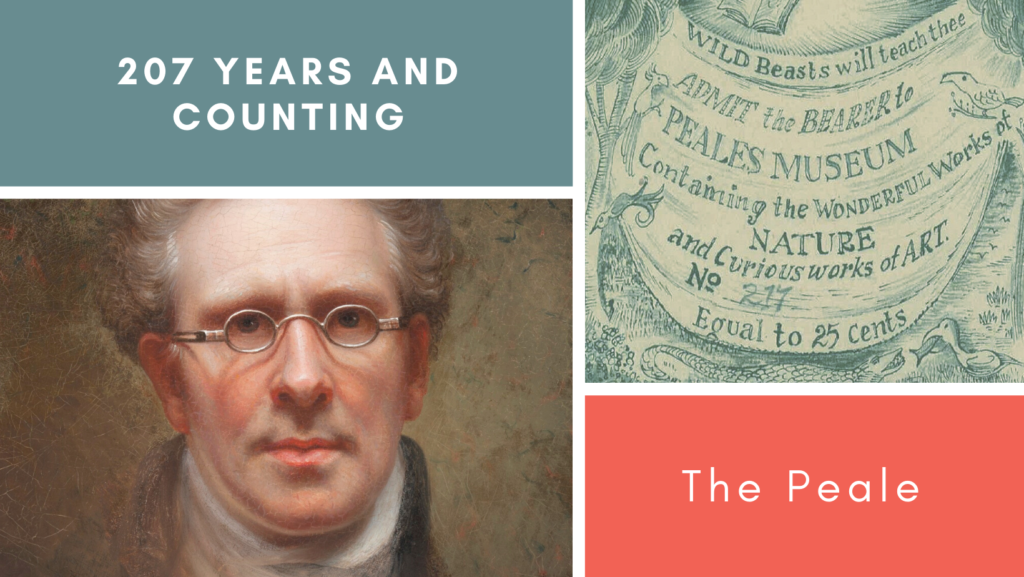
On the left, a portrait of American artist Rembrandt Peale who wears small spectacles, and on the right, a facsimile of an original ticket to the museum in 1815.

Rembrandt Peale to Thomas Jefferson
Philadelphia, July 13, 1813

Dear Sir

In a Box of Books which general Armstrong presented to the Pennsylvania Academy of Fine-Arts there were packed up several articles belonging to himself which he requested me to take charge of, It was a long time after I had them before I remarked a small package for you, containing 3 Stones which you were desirous of possessing, accompanied with a letter from the gentleman who purchased them for you. The small piece which he mentions having cemented, I found again loose—but no other damage. Dr marks & afterwards a near neighbour of yours promised to take charge of them but they failed giving me notice of their departure, and I now remit them by Mr Correa for whom they have been long waiting.

Having purchased the museum in Baltimore, I mean to form a handsome establishment in that City, the general plan of which will differ from my fathers museum, it being my intention to render it more properly a museum of Arts & Sciences, and, without neglecting any branch of Natural History to bestow my chief attention to the formation of a Picture Gallery & Depository of the course and products of Manufactures.

I still hope some fortunate leisure will enable me to pay a Visit to Monticello. In the meanwhile believe me Sir

Your friend.
respectfully,

Rembrandt Peale


Thomas Jefferson to Rembrandt Peale
Monticello, VA, August 11, 1813

Dear Sir

I duly recieved by mr Correa your favor of July 13 and with it the peices of agate & Madrepore sent me thro’ Genl Armstrong & to your care. the transaction stated in the letter accompanying them had so entirely escaped my memory, that the name being subscribed in illegible characters, I am not able to ascertain from whom it comes. I am not however the less obliged to one who recollects to do a kind office when I had forgotten the having requested it. I sincerely wish you success in the establishment of your museum. these things kindle a thirst for knolege, and often draw to useful objects those who would otherwise employ themselves frivolously. should any circumstance ever lead you within striking distance of Monticello I should be very happy to recieve you. Accept the assurance of my great esteem & respect.

Th: Jefferson

Rembrandt Peale: On the Eve of War

On the left, a portrait of American artist Rembrandt Peale who wears small spectacles, and on the right, a facsimile of an original ticket to the museum in 1815.

This summer, as the Peale Museum building approaches its 207th birthday, we’ll be featuring quotes, excerpts from letters, and advertisements that shed light on the Peale family and their Baltimore Museum. The museum was nearly derailed its opening week because the British were invading! On August 22, 2814, founder Rembrandt Peale wrote to his brother Rubens:

“It has not been in my power to write to you since the Alarm here. Every Citizen being commanded to bear Arms . . . The Intelligence at present is that the British are landing in the Patuxent & Potomack at considerable force, it is said 4000 at each place. Washington is supposed their object. Troops are pouring in from all Quarters 3 or 4000 marched from here yesterday.

As the time of trial had now come I endeavored to persuade myself to join in the general defences, but I found it impossible to shoot at a human being, [that] I never had borne arms & never could.

The Captain threatened to arrest me & truly I found that every delinquent was brought to the ranks under guard & that they refused to take Substitutes or fines. But jud[g]ing of the law for myself I stood my ground and charged the Captain not to Arrest me as one conscientiously scrupulous for that my example would do others no good and that he would lose the services of those who guarded me . . .. Wm. Bend has marched off to Washington, Mr. Coale & multitudes of my friends–So that with their absence & the grief of the Women my income is stopped, there having been only 4 persons in the Museum on Saturday morning & one in the afternoon.

I had begun the Portrait of Mrs. McKim but the alarm prevents her sitting as well as others. I have therefore leisure to go on with my improvements if I had money–but unfortunately I paid away all my money as fast as I received it . . .. Until the Alarm I was doing very well averaging about 15$ per day besides a few Tickets & was just about making an Arrangement with some friends by which I might be able to finish the dwelling part of the House–but all this must be suspended until the military rigour is relaxed–& the Citizens restored to their families.


Miller, Lillian B., ed. “The Selected Papers of Charles Willson Peale and His Family,” vol. 3, The Belfield Farm Years, 1810-1820. New Haven and London: Yale University Press, 1991, pgs. 258-9.

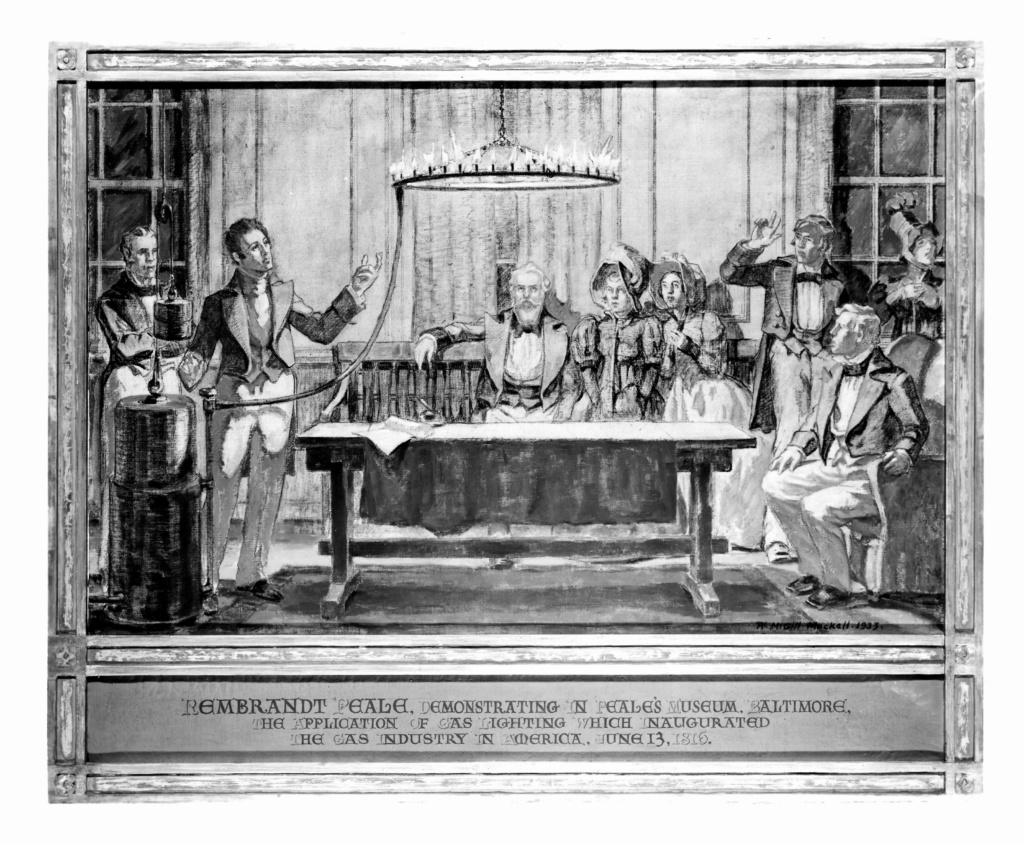
Peale Trivia: What did Rembrandt Peale demonstrate in the galleries?

Image courtesy of the Baltimore Museum of Industry Archives, BGE 36T

What did Rembrandt Peale demonstrate in the museum galleries?

Correct Answer: Peale demonstrated gas light! (Sure, he probably embalmed turkeys too, but we don’t have any documentation for that!)

> Find out how you can support innovation at the Peale!

In addition to being an artist, natural scientist, and museum director, Rembrandt Peale shared his family’s talent for innovation and entrepreneurship. He demonstrated gas light in his galleries, using the new energy technology of the day as an attraction to sell evening tickets to visit the museum.

It has been said that people would stand on Holliday Street in front of the Peale Museum marveling at the brightness of the light coming from its windows – an unprecedented sight in a world of candles and oil lamps. By 1817, Peale had started the Baltimore Gas Company and secured the contract to supply gas street lights throughout Baltimore – the first city in America, and among the first in the world, to be lit by gas – hence its nickname, “Light City.” Peale manufactured the gas in a shed at the back of the museum, and it was supplied to the city in wooden pipes made from hollowed out logs. Two hundred years later, the business Rembrandt Peale founded at his Museum is one of the oldest in the world: Baltimore Gas and Electric (BGE), an Exelon Company.

Peale Trivia: The Fate of the Peale Museum

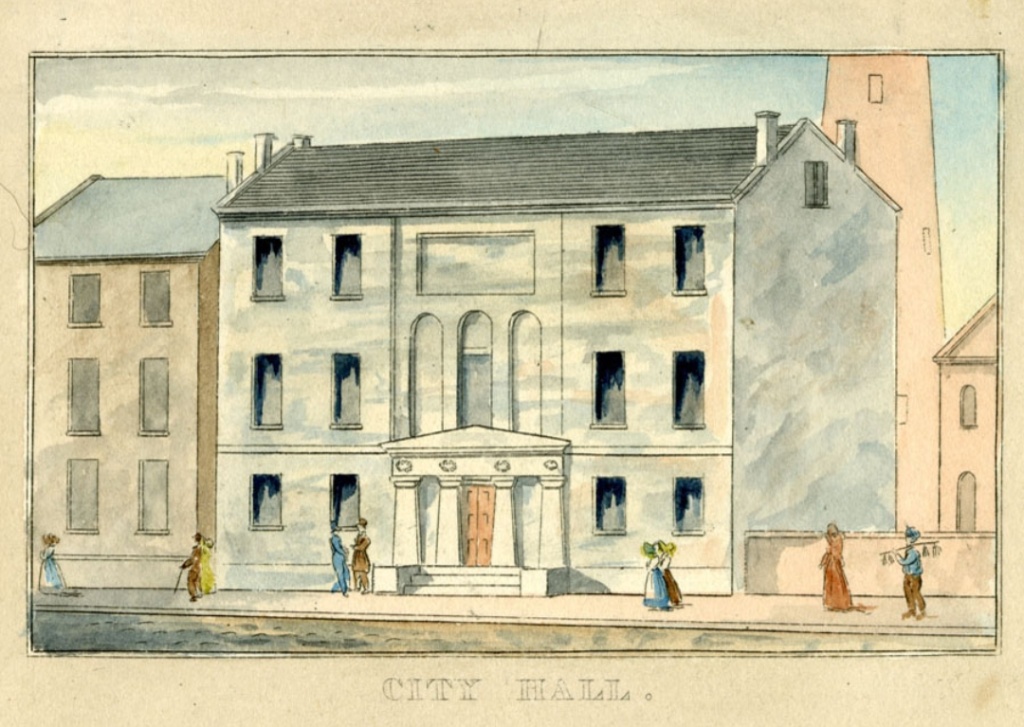
A watercolor of the Peale Museum as City Hall, painted in the 19th century

What happened to Rembrandt Peale’s Museum after it closed in 1829?

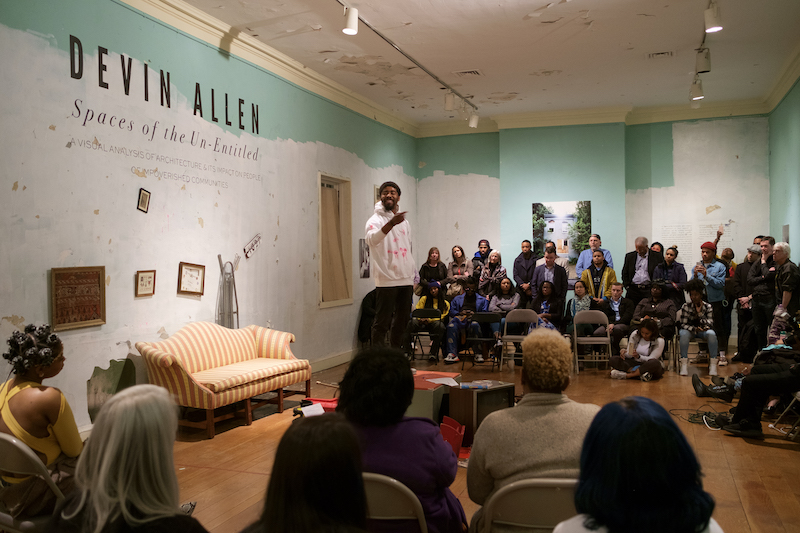
Shortly after Peale’s Museum closed in 1829, the City of Baltimore bought the building for use as the City Hall (1830-1875). The large gallery facing Holliday Street on the third floor, which Rembrandt Peale had used as a lecture hall, became the Assembly Room, where Baltimore’s City Council met, taking advantage of the room’s excellent acoustics and abundant natural light in an age before electricity. The room remains popular with artists and performers today, and is currently under renovation!

Devin Allen performs during his 2019 exhibition, Spaces of the Un-Entitled, in the gallery that served first as a lecture hall, then as the Assembly Room when the Peale Museum building became Baltimore’s first City Hall in 1830.


> Find out how you can support the Peale’s current reopening and renovations!

According to a recent Historic American Buildings survey, “the primary source of information regarding the extensive alterations to the building at this time is a series of construction bills, some signed and annotated by architect William F. Small, in the City Hall archives, Baltimore.” Those alterations include:

• West and south elevations stuccoed, in a method referred to as “granitework,” indicative of a faux ashlar treatment of scored joints to suggest blocks and gray finish color 11
• Central bay of frontispiece, entry level, recessed, and a three-bay Doric portico with seven wreaths on frieze were added. Blind rectangular panel above second level arcading appears “blank” in early images, indicating that signage for Peale’s Museum must have been affixed and removable, probably a wooden panel
• Granite steps and flanking plinths added; also two cast-iron boot-scrapers
• Roof receives wooden shingle treatment with copper flashing.
• Gutters installed; water table and belt course are cut into existing masonry
to receive down spouts
• Nine brick chimney caps installed
• Lightning rods installed
• Sash weights ordered, probably for installation on existing windows, as no orders for new sashes survive
• Shutters and hinges purchased and installed
• Four large granite stones ordered, for unspecified use, possibly as footings in main building
• Existing double entry doors receive glazed insert panels
• Partition wall installed on second floor, west gallery
• Many joists and framing lumber ordered, suggesting some extensive reframing, possibly a “leveling out” of the stepped floor of the third story lecture hall (west) and related adjustments to ceiling level on second story
• Large mahogany newel, corresponding to existing element on entry level, installed, indicative of some alterations to staircase at this time
• Vault doors ordered, location of vaults unknown
• “Patterae,” two chandelier hooks ordered, possibly as part of interior decorative upgrade that includes extensive list of furnishings and fabrics