Going up! The Peale’s elevator reaches new heights

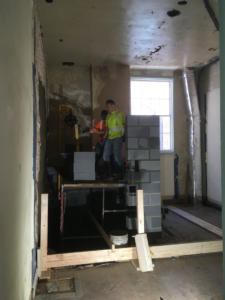
The Peale’s new elevator shaft reach the third floor last week! It will have an accessible, single occupancy restroom next to it when complete, one of five such restrooms that will be available to visitors in the fully renovated Peale.

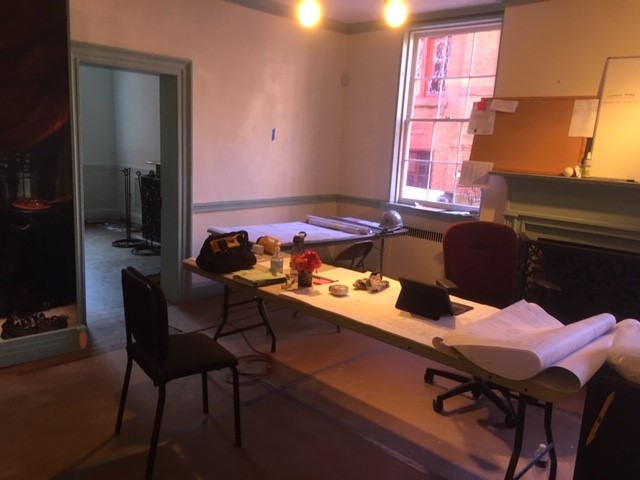
You might recognize this room as Submersive Productions’ lab at the Peale in 2019. In Rembrandt Peale’s day, it served as a painting studio, and still has the extra tall doorway that allowed for massive canvases, like his The Court of Death (1820, Detroit Institute of Arts), to be moved into and out of the studio.

Final renovations at the Peale have begun! 

The “Peale Gallery” at the Peale, the room where we have shared the stories of the Peale family and building, has become the site office for the final round of renovations now underway. With Charles Willson Peale watching from the replica of his 1822 self-portrait, The Artist in his Museum (the original is in the collection of the Pennsylvania Academy of Fine Art), the construction supervisors follow the renovation plans drawn up by our architects at SM+P.

The building has been mostly emptied, but a few heavy objects remain, including that massive Peale replica painting at left in this photo (part of the amazing “Mermaids, Mummies, and Mastodons” exhibition that told the story of early American museums at the Peale in the early 1990s; you can still get the seminal catalogue of the exhibition in our online shop). You can also just make out an ornate metal window guard serving as a screen in the fireplace this room. It is one of many that were brought to the Peale to save them when the 1820s building whose windows they protected was being torn down – and they weigh a ton, almost literally!

How will we continue to safeguard – let alone move – these weighty objects during the renovations? Stay tuned to find out in the Peale’s renovation chronicles, coming to your inbox in our e-newsletter and available in the News section on our website!

“Pealed Every Which Way” Projects

On view earlier this spring, the Pealed Every Which Way exhibition was created by by Goucher College students and featured site-specific individual works, sounds, performances and stories that responded to the Peale Museum building and history.

Not only did students have an opportunity to create installations, they also produced digital publications and stories. Check them out!

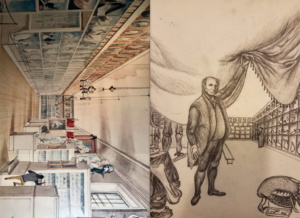
An illustration showing the interior of what the Peale Museum may have looked like in the 19th century, juxtaposed with a drawing of Charles Willson Peale, lifting a curtain to reveal his museum.
An illustration from “Flip Me,” a Goucher College student project.

Scary Story
By Tia Resham Cheema, Katie Chen, Marissa Grant, Dina Diani
An interactive website and digital ghost story!


Camera Obscura
By Will Kirby
A comprehensive photobook showing Camera Obscura techniques as employed at the Peale


Flip Me
By Alexis Liszewski
A beautifully drawn custom flip book, featuring the Peale and its patrons


Peale Center Project
By Maddy Romberger
A combination of drawings and photographs, covering the Peale’s long history and impressive architecture


(Peale)ing Pictures
By Camryn Agostino
Coming Soon!


Story of the Floor
By Melina Albornoz
Coming Soon!


Perspectives
By Vela Culbert
Coming Soon!

Restoration of a 19th Century Gas Pole and Fire Alarm Box at the Peale

Thanks to the continual help and support of Baltimore Gas and Electric, the restoration of a nineteenth-century gas pole and fire alarm box is complete! The pole was lifted out of the back garden of the Peale Center for Baltimore History and Architecture by volunteer BGE engineers and was taken to be restored by David Conrad of Baltimore Foundry Works on an early Saturday morning in March. The pole was initially installed on the South East corner of Monument Street, and Park Ave (see photograph provided by Kevin Larmore) in 1906. When the City’s call box system was shut down in the middle of the twentieth century, it was installed in the historic Peale Museum’s garden. Now you may be asking, what exactly is a fire alarm box, and why is it significant?

Baltimore first installed its call box system in 1859-1860 and was the first line of defense when it came to fires within the City. Each call box had wiring running to the central office, which was located on the second floor of the Peale Museum building, by then being used as City Hall, from 1859 up until 1896. When the fire alarm box was pulled, the central office would get the signal and would relay it to the appropriate fire station. When the firemen arrived at the scene, they would signal back to the central office by pulling the alarm box several more times, utilizing Morse code to communicate if they needed more men or equipment. In this way, the Peale served as the nerve center for the city’s fire alarm system.

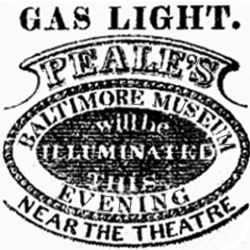
The Peale Museum’s founder, Rembrandt Peale, had introduced another new technology, gas lighting, to his galleries two generations before. In order to attract visitors at night and sell more tickets to his Museum and Gallery of Fine Arts, in 1816 Peale began illuminating his galleries with gas light chandeliers on specially-advertised evenings. By 1817, Rembrandt Peale and his partners had founded the Gas Light Company of Baltimore, which is today Baltimore Gas and Electric, and secured the contract to supply gas streetlights throughout the City of Baltimore. Through his efforts, Baltimore was the first city in the United States, and one of the first in the world, to be illuminated by gas lighting. Gas lights lined the streets of Baltimore up until the late 1950s when they almost entirely removed. Through the restoration of this pole and fire box, it will serve as an excellent artifact to showcase this aspect of Baltimore’s innovative history.

See the renovation process below!

[envira-gallery id=”2737″]

Peale Center’s New Roof Nears Completion

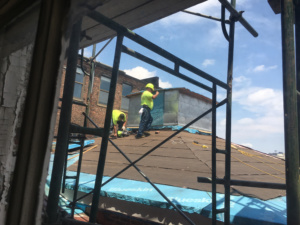
The Peale Center’s new roof is almost finished. This is the first step in restoring America’s oldest museum building, a National Historic Landmark. Plans call for the building to reopen in 2020 as a center for Baltimore history and architecture.

The work is being done by Ruff Roofers, a firm that has put new roofs on other iconic structures in the city, including the base of the Washington Monument, the Old Otterbein Church, Stanford White’s Lovely Lane Church (Spanish tile), and the copper dome that crowns the cupola of Gilman Hall, centerpiece of the Johns Hopkins University’s Homewood campus.

The Peale Center’s new roof is a standing seam metal roof, “basically a copper roof with a tin-zinc coating,” according to Tim Caldwell, general manager of Ruff Roofers, who is supervising the work. The old roof on the building, installed in the early 20th century, was also a standing seam metal roof made of galvanized steel coated with lead. The material was known as terne, and required painting, he said. The old roof had been repaired in 1970, when major renovations were made to the building, but leaks had developed since then, causing damage to the interior walls and decorative plasterwork.

When they tore off the old metal roof, Caldwell said, they found underneath wooden skip sheathing. This was made up of random width boards, some with a bark texture, that were mostly 18-22 inches wide, indicating that had been cut from the center of the tree. This material was left in place, covered with half-inch plywood, and the new metal roof installed over it. Caldwell said the new roof will have a 50-100-year lifespan.

An important element of the project was re-constructing the lantern and skylight that top the rear hip roof of the building. (The main portion of the building facing the street has a pitched roof.) The lantern structure was removed with a crane, taken to the shop, refaced with the same material as the roof, re-glazed, and then put back on the building, again with a crane. The skylight lights the second-floor space that was once Rembrandt Peale’s art gallery and will become a presentation and exhibit hall in the new center.

For a building, the roof is the main line of defense against the elements, according to Caldwell. “It’s amazing how quickly water can do damage; it will rot wood, freeze and expand in masonry,” he said. “The roof is one of the first things you need to do to protect a building.”

Rebuilding and capping the chimneys, re-pointing the exterior brick and restoring the masonry, including the sandstone sills, is also ongoing as part of the same contract. Academy Stone is the contractor for the masonry restoration; this work is expected to be finished in about six weeks. The total cost of the first phase of the Peale restoration is about $700,000, including roughly $500,000 for the new roof. It is being paid for by the City of Baltimore, which owns the building. SM&P Architects is the designer and the Baltimore Department of General Services is overseeing the project.

[envira-gallery id=”1848″]
Roof Renovation Update

The cupola over the Peale’s picture gallery.

Baltimore City’s Department of General Services is in the final stages of replacing the Peale’s roof and restoring the exterior masonry. Renovation has now begun on the cupola that gives natural light to the “picture gallery.” It was the addition of this gallery to the Federal-style row house that made Rembrandt Peale’s 1814 museum an architectural innovation by Robert Cary Long, Sr.

The replacement of the Peale’s roof and restoration of its exterior is being undertaken by Baltimore City’s Department of General Services.

Completion of the renovation work is planned by end of Summer 2017. The Peale is open for special events and available for rental throughout the renovation of the building’s exteriors. Contact us if you have questions or would like to visit!

Call for Research: Colored School No. 1 at the Peale Center

Colored School No. 1 at the Peale Center

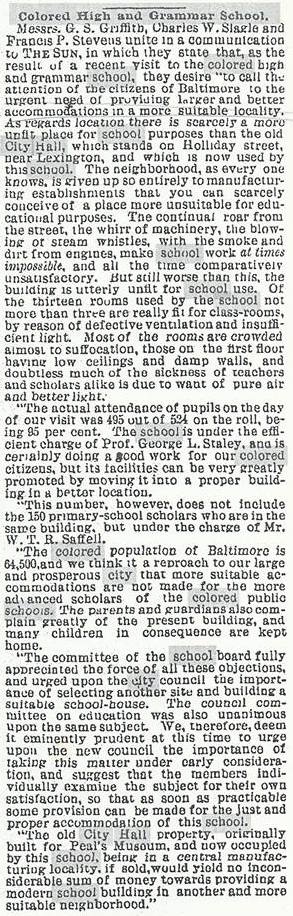
Baltimore Sun article on "The Colored School," 1885.
Baltimore Sun article on “The Colored School,” 1885.

In 1865, at the end of the Civil War, an organization called the Baltimore Association for the Moral and Social Improvement of the Colored People was formed. The association raised money and opened a number of free schools for black children. The city agreed to contribute $10,000 as well.

In 1867 the city council voted to operate schools for black children, replacing all black teachers with white ones, and with that the Baltimore Association turned its buildings over to the city. Some were closed, some were refurbished, and some were used in their existing condition. The Baltimore City Council opened 13 primary schools but no grammar or high schools were established for blacks because it was thought “neither advisable nor practical to provide grades or schools for this class of people.” (This generation made distinctions among grade schools and primary schools and high schools.)

In 1869 the city council opened publicly funded grammar schools for blacks and one was started at the Peale called Colored Grammar School Number One.

1878 “By a resolution of the City Council, the Inspector of Buildings was directed to alter and repair the old City Hall building on Holliday street, for the use of Colored Primary Schools No. 1, and these schools are now occupying their new apartments with better light and ventilation and more comfort than they have ever had since their organization.”

In 1882 a Colored High School with a two year program was housed with the Colored Grammar School in what the minutes say was “The old city hall at Holliday near Lexington.” After six years it moved to a new building on Saratoga and in 1889 its graduates (there were 18 in the first classes) were certified to teach.

In 1883 the Annual Reports of the Board of School Commissioners recorded, “The building occupied by the Colored High and Grammar School and Male Colored School No. 1 is not a suitable one in scarcely any respect. It is not well arranged and some of the rooms are too small and very badly lighted. In some of the rooms, on the lower floor, it is scarcely possible to see sufficiently well to read on cloudy days. If, in case of fire or for any other cause, it became necessary to move the children quickly out of the building, great difficulty would be experienced on account of the narrow stairway down which pupils on the third floor have to pass in getting out of the building.”

“In Baltimore at the end of the 19th century is one of the most intriguing periods of the building’s history, but so far little is known about this period. Here are a few notes we have from Peale Center board members Jean Baker and Jim Dilts; please add to our knowledge base if you can, and forward this request for information to anyone you know who might be able to help!” –Nancy Proctor, Peale Center Director

By 1884 things hadn’t improved: the stairway was still a hazard, and “This neighborhood is too noisy for the location of a school.”

Afterwards, the poor conditions persisted and in 1887, the School Commissioners reported that there was a “building in course of erection on Saratoga St. near St. Paul for the use of Colored High and Grammar School and Male and Female Colored School No. 1 [to] furnish these schools with ample accommodations.”

Can you help fill in the details of the history of public education for African Americans at the Peale? We’re keen to learn more about this pivotal chapter in Baltimore history, and look forward to hearing from you!

  • Articles by Bettye Collier Thomas in the Maryland Historical Magazine
  • Annual Reports of the Board of School Commisioners 1878-1887, notes by Jeff Korman, June 5, 2007
  • MA thesis at Howard University on the History of Public Education in the city of Baltimore by Vernon, Vavrina