Composer Scott Patterson Comes to the Peale on August 8

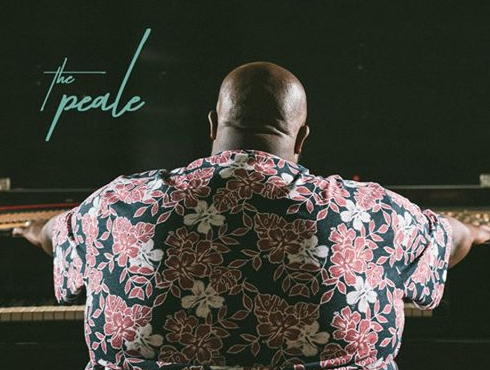
Scott Patterson's back faces the viewer as he plays the piano.

“Scott Patterson may turn out to be one of the most important composers of the 21st century,” predicts Peale Center director Nancy Proctor after seeing Scott play last year. “As an audience member, I can say that his original compositions, which blend an incredible range of genres and instruments, from the Peale’s 19th-century piano to 21st-century beat boxing, are moving in a way I’ve never heard before.”

Last fall, the Peale was fortunate to host the premier of Scott’s operatic ballet, the Cease & Desist Ballet, created by Afro House Baltimore, an organization that’s “committed to the development of a music culture that is disruptive, exuberant, innovative, emergent, and transformative.” Proctor says she’s been a fan ever since seeing the ballet at the Peale Center.

She’s not the only one who’s taken note of Patterson’s performances. The Pittsburgh Tribune-Review describes Patterson’s playing as, “a masterly blend of virtuosity, singing style and beautiful voicing.” His blend of classical, soul and rock music is futuristic, emotive and luxuriant. Early this year, Scott received the $40,000 Mary Sawyers Imboden Prize, the largest artist award given in the region.

Scott has toured with Camille A. Brown & Dancers andat numerous venues, including the Lincoln Center, Belfast Festival at Queen’s, White Bird, The Joyce Theater, and Debartolo Performing Arts Center. He is contributing composer of the Bessie Award winning Mr. TOL E. RAncE and Brown’s critically acclaimed work, BLACK GIRL: Linguistic Play.
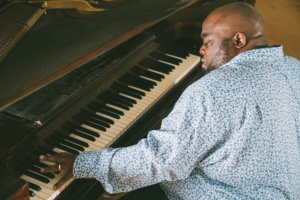
Scott Patterson plays a vintage piano.

Here in Baltimore, Scott has taken on a new challenge: composing new pieces for the Peale’s 1879 Knabe Square Grand Piano – a very different sounding instrument from a modern piano. He’ll perform in the Peale’s historic Picture Gallery on August 8, and the performance will be recorded by Peale residents, ArtsLaureate, for publication. The Peale gratefully accepted the piano from the Baltimore Museum of Industry because it dates to the period when the Peale was Male and Female Colored School No. 1, and Baltimore’s music scene first took flight: the decade when musical instrument manufacturers accounted for over 1% of the city’s GDP (there were three piano manufacturers in Baltimore in that period), and Ford’s Opera House hosted no fewer than 24 different opera companies! (See Jackson Gilman-Forlini in Maryland Historical Magazine, Spring/Summer 2017). This was the dynamic music scene into which Baltimore legends like Eubie Blake were born.

Symbolically, Scott’s concert brings together the birth of Baltimore’s modern music scene with the origins of public school education for people of color in the city and is an opportunity to think about the connections and legacy of both these historic moments for contemporary life in Baltimore.

The staging at the Peale will be unusual, offering an immersive environment to experience the music rather than usual concert seating. Audience members are welcome to bring cushions to lounge on during the performance, a modern-day version of the “groundlings” experience at the original Globe Theater!

An Elegant Rendezvous with Scott Patterson
August 8, starting with a champagne toast with Scott at 7pm, doors for general admission at 7:30pm, and the concert at 8pm.
Get your tickets through Artful.ly or Mixolo.

What is a Time Travel Tour anyway?

You are not alone in asking, as this is a unique new way to experience history!

Part puzzle, part exhibit, part performance, total immersion!

The Time Travel Tours experience is an interactive exhibit that engages with the history of the Peale and its founder in 1818, and connects certain aspects of that time to ours and to the future.

Watch this interview with tour guide David London to learn more, and get tour updates here or call 1-866-TMETRVL.

Click here for times and tickets.

Tours are also available for groups and by special appointment: contact us at events@old.thepealecenter.org to schedule yours. 

Catch the last two episodes of the Institute of Visionary History

Find out why one person called these unique immersive theater performances “visually and emotionally vivid!”

Here’s the back story! Discovered in the basement beneath The Peale Center, the Archives of the Deep Now are the records of a centuries-old secret society calling themselves The Institute of Visionary History. The Institute believed the building to be a kind of “thin place” where one can more easily transcend our present reality and contact other planes, places, and times. Their experiments combined scientific inquiry and visionary sight to uncover histories heretofore untold.


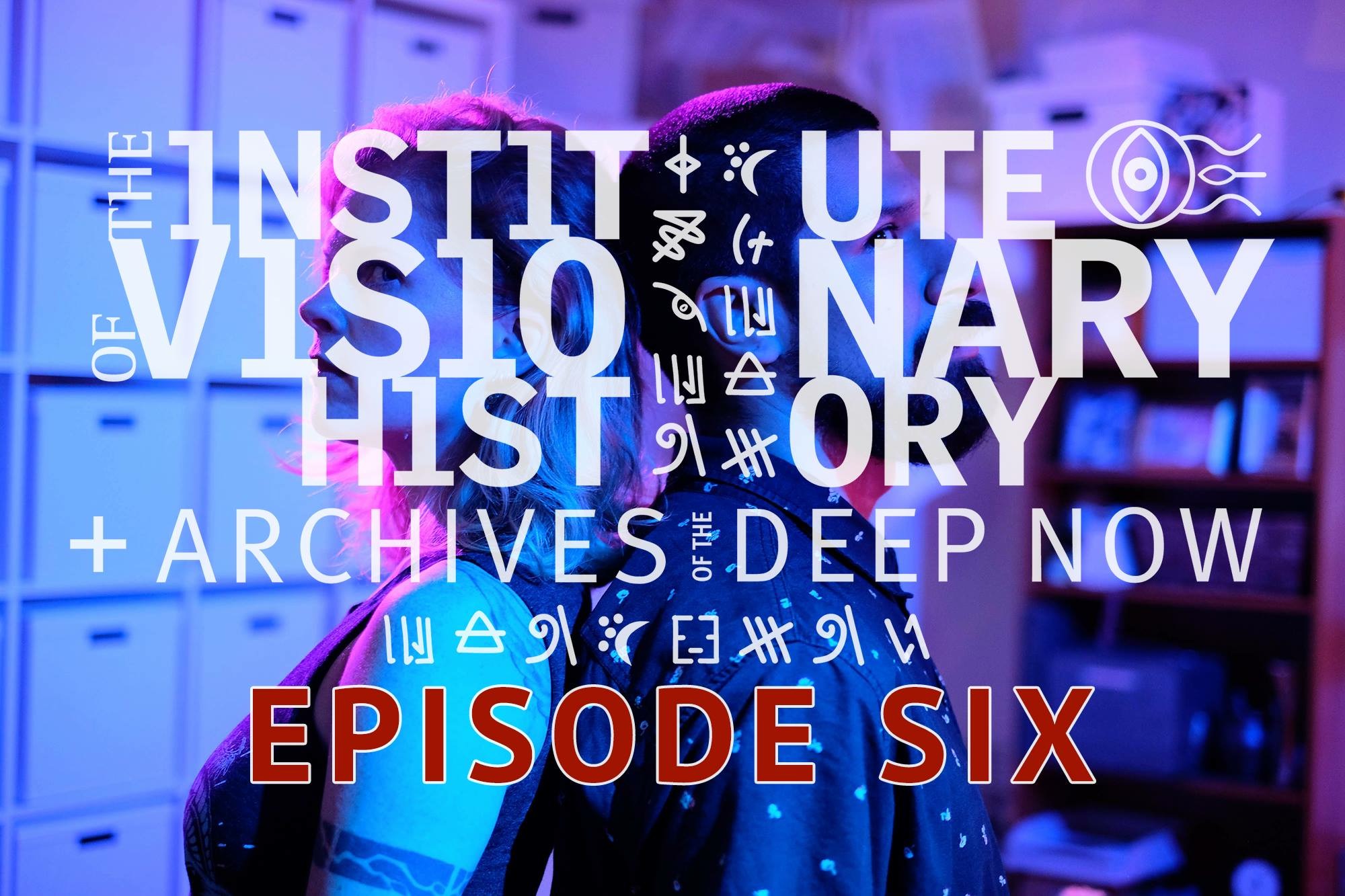
EPISODE SIX: “A HORSE BY THE TAIL IN THE NIGHT. RUNS NOVEMBER 10, 17. TIMED TICKETS

Two obscure aristocrats are fated to dine together indefinitely over the course of an evening that will not cease. Cursed with abundance, they chew away the hours, their food and drink complemented with the bitter fruits of their recollections; spiced with regret and desire, mellowed with well-worn stories. Any attempt to exhaust the inexhaustible is doomed to fail. But like a finely cured meat there is pleasure to be had in consuming the decay and even more in sharing it with whom you may. (Yes, Episode Six comes before Episode five!). Each experience runs 45-60 minutes for a group of up to five people.

EPISODE FIVE: “SHE WHO SEES AND HEARS THE CRIES OF THE WORLD” RUNS NOVEMBER 29-DECEMBER 2. TIMED TICKETS

This experiment was originally conducted in 1836, but was so disastrous the results were suppressed for almost 200 years…until an anonymous informant gave us new information in an effort to answer the question: “How can one escape a curse?” (Actualized by Elizabeth Ung.)

Please note: The Institute is recommended for ages 12 and above. You will be required to ascend and descend at least two staircases at a relaxed pace. Plan to arrive a full ten minutes before your scheduled start time and to spend about an hour (or more if you choose) at The Peale. Beverages and light snacks will be available (donations appreciated). Restrooms will be accessible before and after the experience. Coat racks and safe storage for bags will also be available. Each experience runs 45-60 minutes for a group of up to five people.

BootPrints: Immersive Performance 30 June 6pm

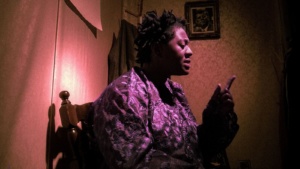
An African American woman in a purple shirt sits in a chair in a dark room, speaking to the audience.Join us at the Peale on Saturday, June 30 at 6pm for the final live performance of BootPrints, including a staged reading with chorus and the immersive exhibition, followed by a conversation between the playwright, Latonia Valincia-Moss and Angela Carroll of BmoreArt Magazine. A vegan tasting is included in the ticket price, and drinks can be purchased additionally during the event.

Tickets are $15 in advance and $20 at the door.

“Standing Room Only” extended through July 1

“Standing Room Only,” the exhibition curated by Tiffany Jones of BootPrints, the play and film directed by Nate Couser, can now be seen at the Peale through July 1. At 6pm on Saturday, June 30, in addition to the exhibition, enjoy an Immersive Performance of the production including a staged reading with live chorus and conversation between the playwright, Latonia Valincia-Moss and Angela Carroll of BmoreArt Magazine. 

Tickets are $15 in advance/$20 at the door and include a vegan tasting. Drinks can be purchased additionally.

Self-guided visits to “Standing Room Only” are free and open to the public Thursdays, Fridays, and Saturdays 12-6pm and Sundays 10am-4pm. Advanced booking is recommended.

Bootprints: Standing Room Only at the Peale Museum is an Immersive Experience in Black Memory; review by Angela N. Carroll

Black Grandmothers: Labor, Lace, and Wide-Brimmed Hats

By Angela Carroll

“God specting womens to lay down and gurd up. Womens have to take boots on ‘deir chest and dress shoes, sneakers and cleats too. Women like carpet—all kinds of shoes gotta walk on womens.” – from Bootprints

Latonia Valencia’s dramatic play, Bootprints, is an unsettling but familiar narrative about death, family secrets, and the revelations of those who survive. Bootprints unpacks Black memory and the frustrations of younger generations who grapple with the histories, traditions, and secrets they have inherited.  The perpetuity of Black mourning, Black grandmothers, labor, lace and wide-brimmed hats. Silk and sore backs from working as housemaids, Gmama’s hands, Sunday mornings, all these memories come into focus when Gmama dies.  Her granddaughter Myeshia is left mourning her loss and remembering the impact of her grandmother on her life.

The play opens on Myeshia in conversation with her alternate personality Gingel as they determine what outfit to bury Gmama in.  Gmama had a vast collection of colorful suits and each marked a significant event in the women’s lives; miscarriages, molestation, wealth, abandonment, love, failed marriages, poverty. As Myeshia/Gingel and Gmama’s apparition sort through the suits, they share their memories aloud as epic choreopoems.  Like Ntzoke Shange’s timeless homage, For Colored Girls Who Have Considered Suicide When the Rainbow Is Enuf, Bootstraps uses color, fashion and domestic interiors as cues for the emotional and psychological states of its protagonists. The play honors and humanizes narratives about southern Black women.

Director Nate Couser and Curator Tiffany Jones reimagine the theatrical script as an immersive installation series, Bootprints Standing Room Only at the Peale Museum. The installations convert the second floor of the museum into surreal visualizations of Gmama and Myeshia/Gingels memories. Photographs, prints and collage works from Brianna Faulkner, Antonio McAfee, and I Henry Phillips are incorporated into and/or placed opposite the installations.

In all instances, Jones installations provide powerful imagery that enunciates key moments in the play and offer new perspectives about Black women’s lived experiences. Each installation tugs at the senses. Visitors can take lollipops or mints from any of the many candy dishes spread around the museum/Gmama’s house.  You may smell the sweet dense aroma of incense or the pungent funk of moth balls. You will hear the voice of Gmama, Myeshia and Gingel tell their own stories through looped audio projections. You will surely leave the experience inspired.

Read more…