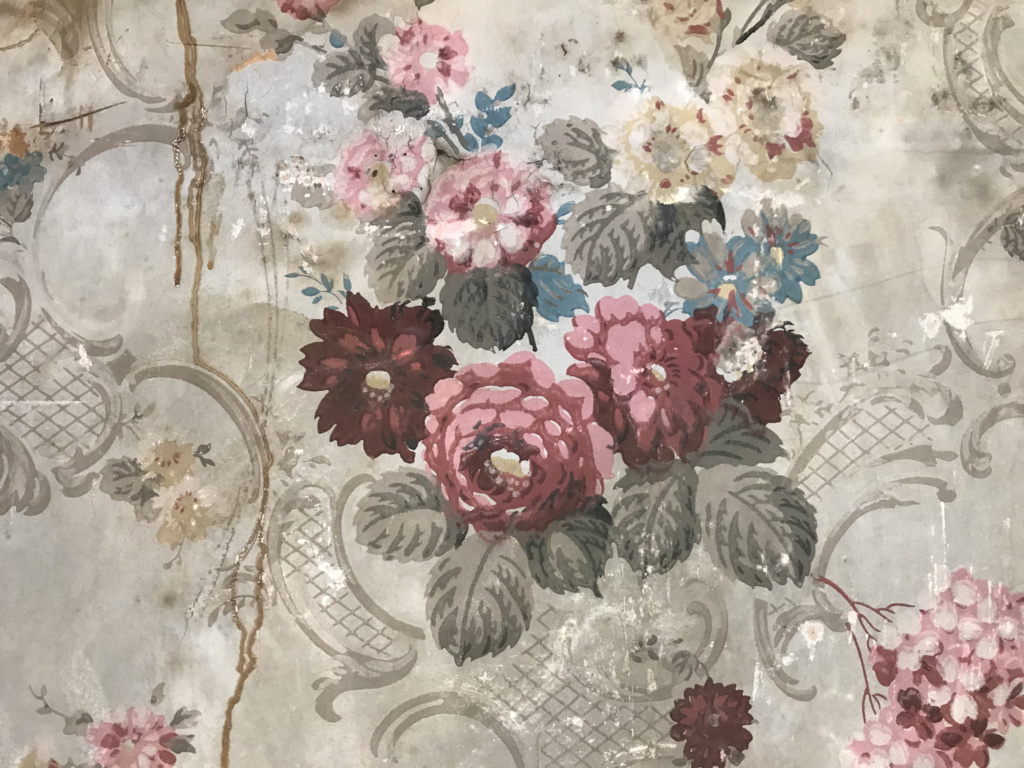
In the past two hundred years, there has scarcely been an element that has had a more decisive impact on an interior than wallpaper. The color, texture, and patterning of paper hangings often determined the character of an interior space. Beyond that, from the 18th century on, the presence of wallpaper—once an expensive commodity—coincided with the rise of the middle class and its emerging ability to purchase luxury items. In essence, the rise in the popularity and affordability of wallpaper is like the burgeoning market for the automobile or the television, both items that were beyond the purchasing power of ordinary people. And, when the masses had cars and televisions, something shifted in the collective idea of what it meant to be “successful.” Such is the story of wallpaper as well. (Read a brief history of wallpaper from the V & A Museum.)
In the investigation of a historic site, it’s just as crucial to study wallpaper as it is to analyze woodwork, plaster, and paint. Yet, the serious study of wallpaper can be overlooked. In our own era, wallpaper is either loved or hated–mostly the latter, and often correlated with feminine decorative arts, jokingly associated with “your grandmother’s house.” Indeed, traditional, local museum collections don’t often contain everyday wallpapers, the way they might showcase silver, furniture, or paintings. On the other hand, design museums like the Cooper Hewitt in New York and the V & A in London have preserved thousands of examples of papers–like velvety flocked paper hangings and huge scenic wallpapers that once covered entire rooms with epic scenes of historical ruins. In their day, these were truly expensive works of art, printed by hand and reserved for the wealthy owners of colonial plantations like Prestwould in Virginia.
But no less impressive are the papers that made their way into more modest Baltimore homes and businesses. As early as 1798, Thomas and Caldeleugh advertised in the Federal Gazette and Baltimore Daily Advertiser, “An assortment of elegant French Paper Hangings of a superior quality, comprising a great variety of new and tasty figures.” (See citation 1)
From this point forward, especially with improvements in the technology after 1840 that enabled machine printing, there were never a lack of promotions for paper hangers and their wares. In the U.K., “production rose from around one million rolls in 1834 to nearly nine million rolls in 1860, while prices dropped to as little as a farthing a yard (0.25p).” (See citation 2)
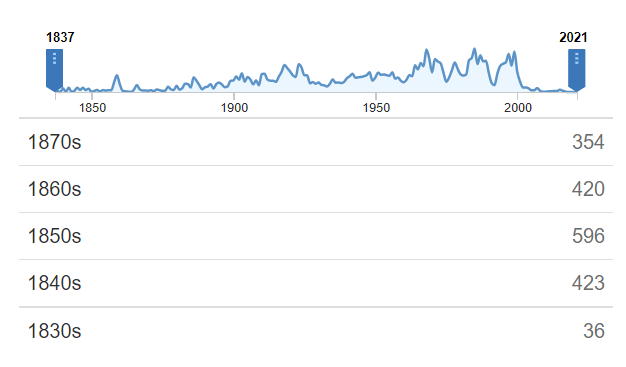
One search of Baltimore papers from Newspapers.com during the 19th century revealed a startling number of advertisements and mentions of paper hangers, again mirroring the changes in technology after 1840.
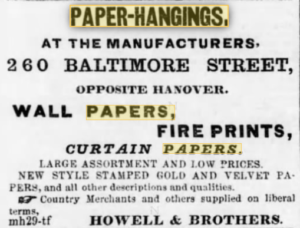
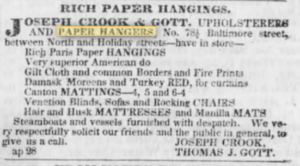
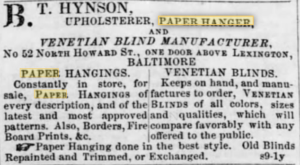
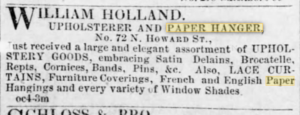
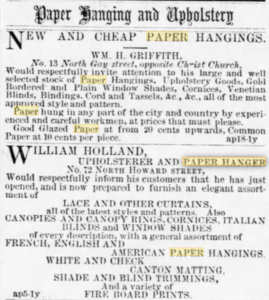
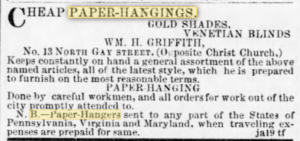
Without the name of a specific manufacturer or receipts that confirm the purchases of paper rolls, it’s difficult to date the paper that we discovered on the wall at the Peale this summer, but based on style, pattern, and similar samples in extant collections, the paper may date to the mid-to-late 19th century. At that time, the Peale was Baltimore’s City Hall (1830-1875). WHY would City Hall have such ornate wallpaper? This is an anachronistic question in some ways, born out of our modern tastes and belief system that public buildings should exude a certain strength and sobriety. However, exuberant, floral wallpapers were so popular at that time, they could have easily been included in public spaces like this one, not only was it attractive, but it also covered up unsightly cracks and kept out drafts–beautiful and practical! Even better, an advertisement in the Pennsylvania Packet from Joseph Dickinson (April 2, 1786) read:
It is found, by experience, that papering of rooms, both walls and ceilings, as well as entries, with this cheap paper, is far less costly, and much handsomer, than white washing.
Jumping forward into the 20th century, patterns and samples that are similar to ours DO appear in the Cooper-Hewitt museum’s collection that date to the 1940s, a time period when our building had already become the Peale Museum. The Peale was renovated in 1930 by the architect John H. Scarff, and his interpretation was purely Colonial Revival, meaning the renovation focused on recreating an impression of idealized colonial life–architecture, design, etc. Therefore, the use of this paper seems unlikely to have been installed at that time.
But, alas, there’s more work to be done here! When the building reopens in 2022, you’ll have a chance to see the wallpaper in person and share your insights with us! Stay tuned!
—Heather Shelton, Digital Curator and Registrar, The Peale
References:
- Lynn, Catherine. “Wallpaper in America: From the Seventeenth Century to World War I,” New York: W.W. Norton & Company, 1980., pg 93.
- A Brief History of Wallpaper, Victoria & Albert Museum: https://www.vam.ac.uk/articles/a-brief-history-of-wallpaper
See other digital wallpaper collections: Historic New England, Victoria & Albert Museum, Metropolitan Museum of Art, Cooper-Hewitt Design Museum