News

Rembrandt Peale: On the Eve of War

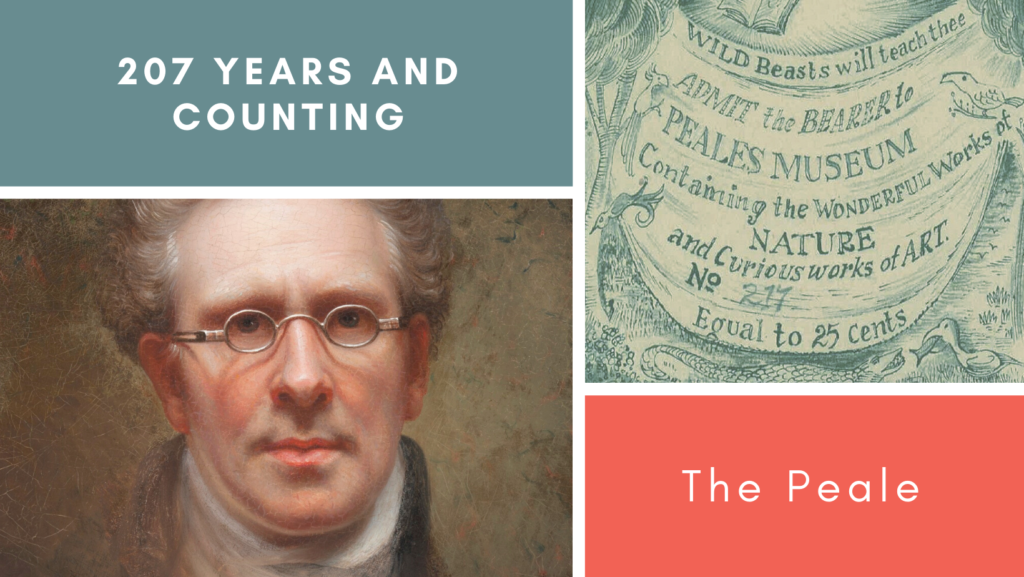
On the left, a portrait of American artist Rembrandt Peale who wears small spectacles, and on the right, a facsimile of an original ticket to the museum in 1815.

This summer, as the Peale Museum building approaches its 207th birthday, we’ll be featuring quotes, excerpts from letters, and advertisements that shed light on the Peale family and their Baltimore Museum. The museum was nearly derailed its opening week because the British were invading! On August 22, 2814, founder Rembrandt Peale wrote to his brother Rubens:

“It has not been in my power to write to you since the Alarm here. Every Citizen being commanded to bear Arms . . . The Intelligence at present is that the British are landing in the Patuxent & Potomack at considerable force, it is said 4000 at each place. Washington is supposed their object. Troops are pouring in from all Quarters 3 or 4000 marched from here yesterday.

As the time of trial had now come I endeavored to persuade myself to join in the general defences, but I found it impossible to shoot at a human being, [that] I never had borne arms & never could.

The Captain threatened to arrest me & truly I found that every delinquent was brought to the ranks under guard & that they refused to take Substitutes or fines. But jud[g]ing of the law for myself I stood my ground and charged the Captain not to Arrest me as one conscientiously scrupulous for that my example would do others no good and that he would lose the services of those who guarded me . . .. Wm. Bend has marched off to Washington, Mr. Coale & multitudes of my friends–So that with their absence & the grief of the Women my income is stopped, there having been only 4 persons in the Museum on Saturday morning & one in the afternoon.

I had begun the Portrait of Mrs. McKim but the alarm prevents her sitting as well as others. I have therefore leisure to go on with my improvements if I had money–but unfortunately I paid away all my money as fast as I received it . . .. Until the Alarm I was doing very well averaging about 15$ per day besides a few Tickets & was just about making an Arrangement with some friends by which I might be able to finish the dwelling part of the House–but all this must be suspended until the military rigour is relaxed–& the Citizens restored to their families.


Miller, Lillian B., ed. “The Selected Papers of Charles Willson Peale and His Family,” vol. 3, The Belfield Farm Years, 1810-1820. New Haven and London: Yale University Press, 1991, pgs. 258-9.
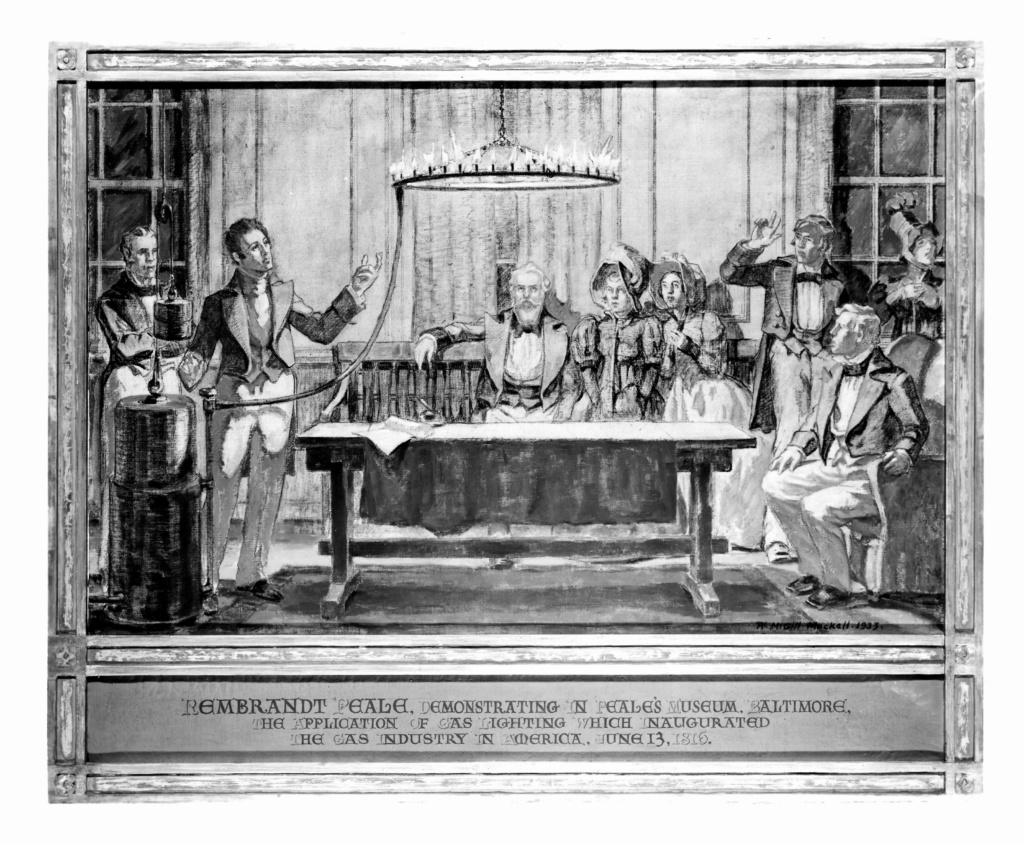
Peale Trivia: What did Rembrandt Peale demonstrate in the galleries?

Image courtesy of the Baltimore Museum of Industry Archives, BGE 36T

What did Rembrandt Peale demonstrate in the museum galleries?

Correct Answer: Peale demonstrated gas light! (Sure, he probably embalmed turkeys too, but we don’t have any documentation for that!)

> Find out how you can support innovation at the Peale!

In addition to being an artist, natural scientist, and museum director, Rembrandt Peale shared his family’s talent for innovation and entrepreneurship. He demonstrated gas light in his galleries, using the new energy technology of the day as an attraction to sell evening tickets to visit the museum.

It has been said that people would stand on Holliday Street in front of the Peale Museum marveling at the brightness of the light coming from its windows – an unprecedented sight in a world of candles and oil lamps. By 1817, Peale had started the Baltimore Gas Company and secured the contract to supply gas street lights throughout Baltimore – the first city in America, and among the first in the world, to be lit by gas – hence its nickname, “Light City.” Peale manufactured the gas in a shed at the back of the museum, and it was supplied to the city in wooden pipes made from hollowed out logs. Two hundred years later, the business Rembrandt Peale founded at his Museum is one of the oldest in the world: Baltimore Gas and Electric (BGE), an Exelon Company.

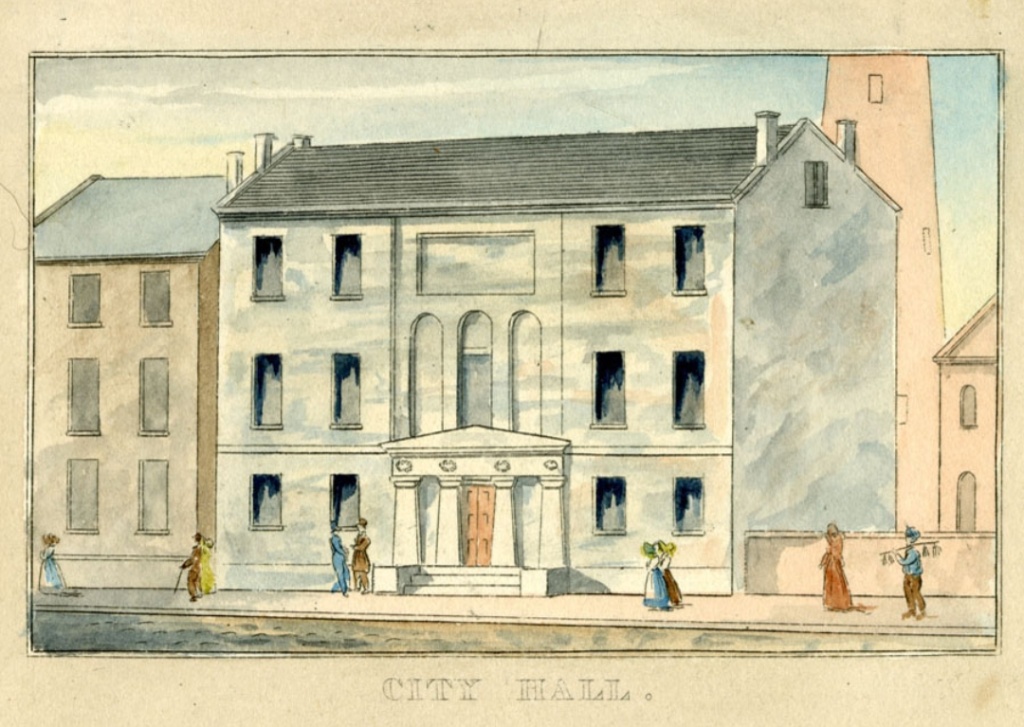
Peale Trivia: The Fate of the Peale Museum

A watercolor of the Peale Museum as City Hall, painted in the 19th century

What happened to Rembrandt Peale’s Museum after it closed in 1829?

Shortly after Peale’s Museum closed in 1829, the City of Baltimore bought the building for use as the City Hall (1830-1875). The large gallery facing Holliday Street on the third floor, which Rembrandt Peale had used as a lecture hall, became the Assembly Room, where Baltimore’s City Council met, taking advantage of the room’s excellent acoustics and abundant natural light in an age before electricity. The room remains popular with artists and performers today, and is currently under renovation!

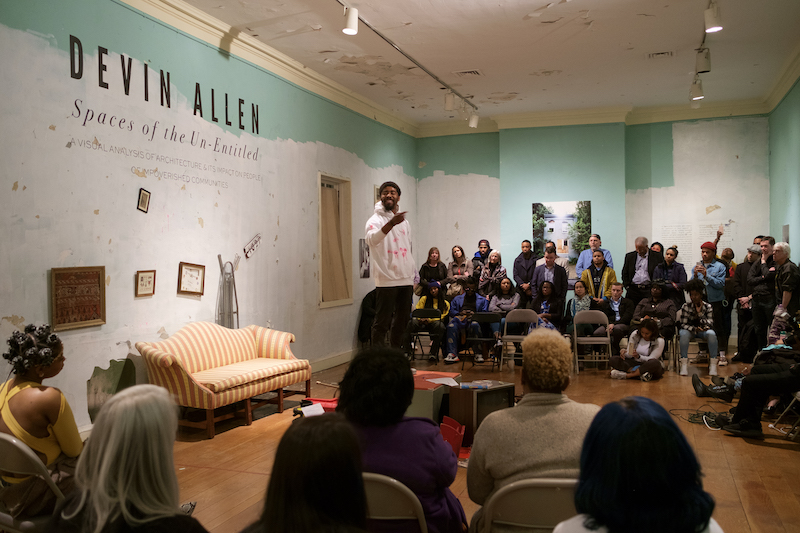
Devin Allen performs during his 2019 exhibition, Spaces of the Un-Entitled, in the gallery that served first as a lecture hall, then as the Assembly Room when the Peale Museum building became Baltimore’s first City Hall in 1830.


> Find out how you can support the Peale’s current reopening and renovations!

According to a recent Historic American Buildings survey, “the primary source of information regarding the extensive alterations to the building at this time is a series of construction bills, some signed and annotated by architect William F. Small, in the City Hall archives, Baltimore.” Those alterations include:

• West and south elevations stuccoed, in a method referred to as “granitework,” indicative of a faux ashlar treatment of scored joints to suggest blocks and gray finish color 11
• Central bay of frontispiece, entry level, recessed, and a three-bay Doric portico with seven wreaths on frieze were added. Blind rectangular panel above second level arcading appears “blank” in early images, indicating that signage for Peale’s Museum must have been affixed and removable, probably a wooden panel
• Granite steps and flanking plinths added; also two cast-iron boot-scrapers
• Roof receives wooden shingle treatment with copper flashing.
• Gutters installed; water table and belt course are cut into existing masonry
to receive down spouts
• Nine brick chimney caps installed
• Lightning rods installed
• Sash weights ordered, probably for installation on existing windows, as no orders for new sashes survive
• Shutters and hinges purchased and installed
• Four large granite stones ordered, for unspecified use, possibly as footings in main building
• Existing double entry doors receive glazed insert panels
• Partition wall installed on second floor, west gallery
• Many joists and framing lumber ordered, suggesting some extensive reframing, possibly a “leveling out” of the stepped floor of the third story lecture hall (west) and related adjustments to ceiling level on second story
• Large mahogany newel, corresponding to existing element on entry level, installed, indicative of some alterations to staircase at this time
• Vault doors ordered, location of vaults unknown
• “Patterae,” two chandelier hooks ordered, possibly as part of interior decorative upgrade that includes extensive list of furnishings and fabrics

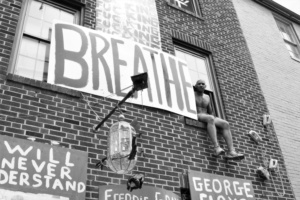
The Day After The Day After The One Year Anniversary Of George Floyd’s Death After That Day…

REJOICE in the SUNLIGHT!
DANCE in the RAIN!
BE APPRECIATIVE FOR
WHAT YOU HAVE GAINED.

A rabid Soul
Tortured & Sickly,
STRIKES OUT
And can change human lives
Into victims so quickly.

How many mass shootings
Since Columbine?
Who do victims & perpetrators
Belong to? Are they
Yours or are they Mine?

How many brutal racist slayings
Since Emmett Till?
Are we born to kill &
Taught to LOVE?
OR ARE WE BORN TO LOVE
& TAUGHT TO KILL?

Are we born greedy
And taught to share?
Are we born thoughtless
And taught to care?

The Philosophers,
The Preachers,
The Politicians,
The Commentators &
The Teachers do not
Have a clue.
They do not know what to do.

Democracy in bed with Slavery!
Hegemony in bed with Democracy!
Democracy in bed with Hypocrisy!
The Doomsday Clock is ticking
REVELATIONS is Predicting.
The Empire will expire.

“O My LORD!
The World saw what we did
To GEORGE FLOYD.

O My LORD!
The World saw what we did
To GEORGE FLOYD.

Sometimes it causes me
to tremble, tremble, tremble.
O My LORD!
The World saw what we did
To GEORGE FLOYD.”

“Don’t have to watch
The News
‘Cause I was born with
The Blues.

No matter which
way I go
I run into Jim Crow.
Yes! Yes! Yes!”

– Linda Goss
Copyright c 2021 by Linda Goss

Stay tuned to hear Mama Linda read this poem in her Chapbook Series in June 2021!

A Tribute to George Floyd

Today, and every day, we honor George Floyd. A loved one whose life was so much bigger than the oppression that killed him. We send our condolences to his family as they continue to grieve his unjust murder.

Here are some tributes from the Peale team and friends:

Mama Linda’s Chapbook: Blues Lamentation for George Perry Floyd, A Poem and Interview
Recorded in the immediate wake of George Floyd’s killing, Mama Linda performs a song she wrote about Floyd and the “rallying cry that was hurled all over this world.” In a companion interview with Baltimore fillmmaker Myles Banks, Mama Linda also reflects on her own history and the hardships of life in 2020.

Artist Loring Cornish sits out the window of Fells Point studio. Photo by Daisy Brown.
Photo by Daisy Brown, 2020.

“Stoop Shoots” by Daisy Brown, Episode 2 with Loring Cornish
The Peale’s storytelling ambassador Daisy Brown talks about her friend Loring Cornish, a Baltimore artist who spoke out about the injustice of George Floyd’s murder last May by displaying a series of poignant paintings outside his studio.

Going up! The Peale’s elevator reaches new heights

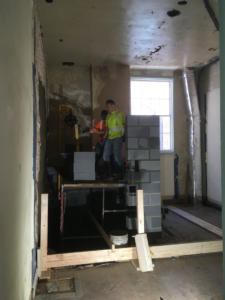
The Peale’s new elevator shaft reach the third floor last week! It will have an accessible, single occupancy restroom next to it when complete, one of five such restrooms that will be available to visitors in the fully renovated Peale.
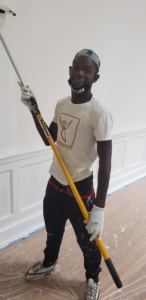

You might recognize this room as Submersive Productions’ lab at the Peale in 2019. In Rembrandt Peale’s day, it served as a painting studio, and still has the extra tall doorway that allowed for massive canvases, like his The Court of Death (1820, Detroit Institute of Arts), to be moved into and out of the studio.

You did it! $50,000 matching goal achieved!

Ty aka “Savage” helped the Peale pilot our “artsforce” development program in Summer 2020.

Thanks to your generosity, we were able to make our $50,000 fundraising goal and double all donations to the Peale’s renovations since April 6 for a total of more than $100,000 contributed to our Capital Campaign! Thank you!! Your support means we will be able to reopen the Peale by early 2022!

Your response to the matching challenge was so inspiring that new donors have offered an additional $15,000 to double donations through June 30. These funds will go towards equipping the Moses Williams Center, the teaching gallery for the Accomplished Arts Apprentices “artsforce” development program at the Peale. Several Peale descendants and others have already contributed to the Moses Williams Center: find out how you can join this “family” of supporters!

The Peale participates in the Smithsonian’s “Vaccines & US” initiative

Smithsonian launches the “Vaccines & US” initiative, a national collaboration of cultural organizations supporting vaccine education

>NOW LISTENING FOR VACCINATION STORIES! Contribute yours today.

A woman with a yellow mask gets a COVID shot.

The Peale has partnered with the Smithsonian and other museums from across the U.S. to help launch a new nationwide initiative, “Vaccines & US: Cultural Organizations for Community Health.” This Smithsonian-led initiative will bring together museums, libraries and cultural institutions across the country to support the national effort to provide Americans with accessible, trustworthy information about vaccines. The initiative shares free resources that local cultural organization can use to help their communities make informed decisions about COVID-19 vaccination.

“Vaccines & US” curates an online hub of resources about COVID-19: the safety, efficacy and value of COVID-19 vaccines, practical advice for having conversations about vaccination, American communities’ and cultures’ response to the pandemic and the history of pandemics and vaccination in the U.S. The initiative invites local museums, libraries, cultural organizations and civic centers to use these free resources to support vaccine education in their communities. From videos and infographics to activities and educational curricula, the scientific content is vetted by an advisory group of medical professionals from collaborating organizations. As part of these online offerings, the Smithsonian sponsored artists and designers to create posters that cultural organizations can download and share with their audiences.

Mama Linda Goss, the Peale’s Storyteller in Residence

The Peale’s Storyteller in Residence, Mama Linda Goss, hosted online conversations with local storytellers about their experiences and concerns about the COVID vaccine. Listen to a selection here!

Learn more about vaccines and how cultural organizations like the Peale are supporting the vaccine effort.

“Crane Day” at the Peale


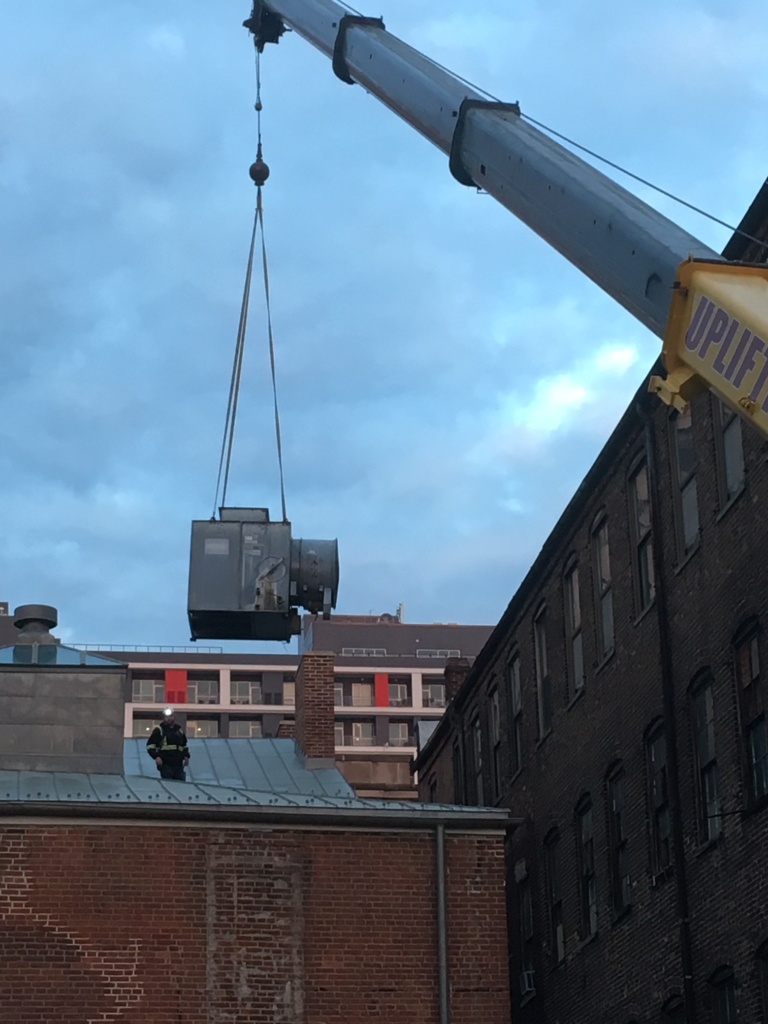
Today was “Crane Day” at the Peale as the old cooling tower was removed at the crack of dawn this morning. A new eco-friendly HVAC system is being installed as part of the Peale’s renovations, funded in part by a grant from the Maryland Energy Administration.

The new HVAC system will be not only more reliable and energy-efficient, it will also be discretely installed in the Peale’s attic so that the Peale’s award-winning roof, which was replaced in 2017 by Baltimore City’s Department of General Services, can be enjoyed in its full glory by passing birds, helicopters, drones, and dirigibles.

Big thanks to our neighbors at Zion Church for letting the crane team into their parking lot behind the Peale at such an early hour! Staff are relieved there will be no more trips onto the roof to kick the cooling system back into operation during a hot summer’s performance. We are grateful to all the donors to our capital campaign who made this day possible!

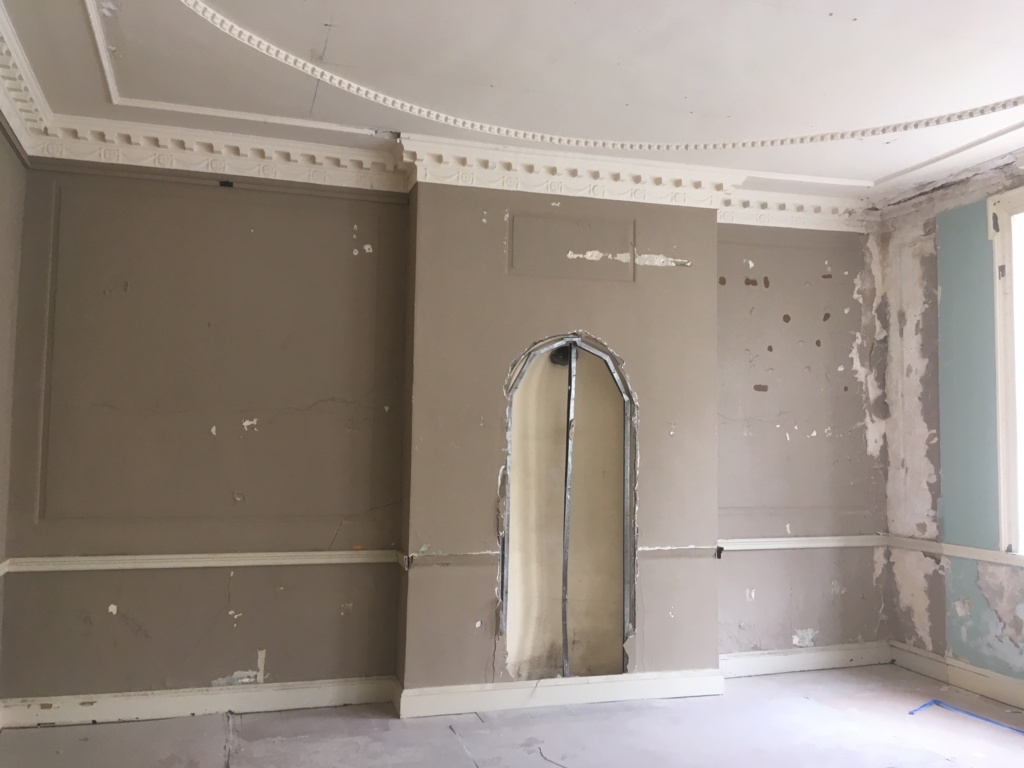
Original stove niches uncovered!

Stove niche in the Peale’s second floor large front gallery.

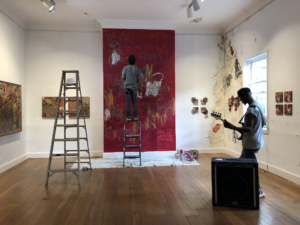
Architect Robert Carey Long, Sr. designed stove niches into Rembrandt Peale’s museum. They were plastered over later in the 20th century, but were still visible after the Peale’s 1930 renovations. In 2019, street artist Adam Stab did a live painting event as part of his solo exhibition at the Peale, creating a mural over one niche in the third floor “Assembly Room” while Ronald Rucker played his “Electronic Art.”

Adam Stab paints in the Peale’s third floor front gallery as Ronald Rucker plays his “Electronic Art.”

It was hard to say good-bye to Stab’s site specific work at the Peale, but as part of the current renovations, Peale’s original niches have been uncovered once more.

John Scarff, architect of the 1930 renovations, which saved the Peale from demolition, wrote of the niches:

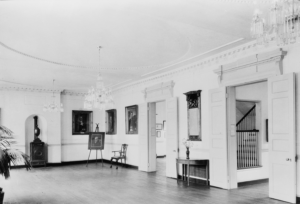
Second floor front gallery in 1936, photo by E. H. Pickering, from the Historic American Buildings Survey at the Library of Congress.

The six stove niches throughout the museum are original and Rembrandt Peale’s account book at the Maryland Historical Society shows that he bought more than one stove for the building. The entirely new radiator enclosures in these niches were suggested by the original stoves in the entrance hall of the Octagon House in Washington, D.C., built in 1800 for John Tayloe.

– Historic American Building Survey (HABS 398-MD) Report by Laurie Ossman, Ph.D., 2001.