News

Volunteer opportunity Saturday 21 July!

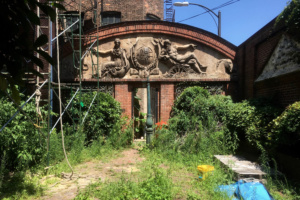
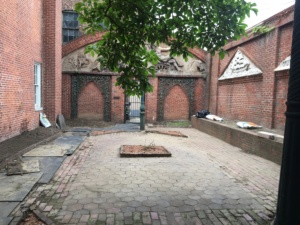
The renovations of the Peale’s historic garden are complete. Now help us finish the planting of the Peale’s Pollinator Garden!

Saturday 21 July 9:30am-12:30pm RSVP

Join land artist Ashley Kidner and friends of the Peale to help turn our historic garden into an oasis for people and pollinators of all sorts.

Before
During…
After!

The renovation of the Peale’s historic garden and its gas lights has been made possible by support from BGE and the Baltimore Foundry Works, the hard work of the National Trust for Historic Preservation’s Hands On Preservation Experience (HOPE Crew) from Morgan State University’s School of Architecture, expert volunteers, and generous donors. Come enjoy their gifts!

HOPE Crew at the Peale

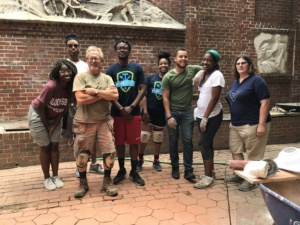
Students and mentors from Morgan State University School of Architecture in the HOPE Crew project at the Peale, June 25-July 13, 2018. L-R: Monique Robinson, Jamil Nelson, David Gibney (preservation contractor), Akiel Allen, Tiffany Dockins, Nathaniel Mitchell, Taylor Proctor, and Wendy McGee-Preti.

Over the past three weeks, thanks to the National Trust for Historic Preservation’s HOPE Crew (Hands-On Preservation Experience), an ambitious team of six architecture students from Morgan State University has been repointing and relaying brickwork in the Peale’s historic garden, repairing decorative ironwork, and repainting our 19th century gas streetlights. Read all about their great work and come enjoy a peaceful oasis in the heart of downtown Baltimore for free on Sundays.

July 10, 2018 Media Day for the HOPE Crew at the Peale

[envira-gallery id=”4045″]

The renovation of the Peale’s historic garden and its gas lights has been made possible by support from BGE and the Baltimore Foundry Works, the hard work of the National Trust for Historic Preservation’s Hands On Preservation Experience (HOPE Crew) from Morgan State University’s School of Architecture, expert volunteers, and generous donors. Come enjoy their gifts!

Press

2018 July 18, Diverse Issues in Higher Education, Morgan State Students Participate in Historical Restoration Program

2018 July 14, Baltimore Sun, Remembering Baltimore’s magical glow from gaslights on a summer night

2018 July 13, Washington Post, Project aims to help diversify architecture, historic preservation fields (repost from Baltimore Sun)

2018, July 11, Morgan State University News, Morgan State University Architecture Students Participate in National Preservation Training Pilot Program

2018 July 10, Baltimore Sun, Morgan project aims to help diversify architecture, historic preservation fields

“Pealed Every Which Way” Projects

On view earlier this spring, the Pealed Every Which Way exhibition was created by by Goucher College students and featured site-specific individual works, sounds, performances and stories that responded to the Peale Museum building and history.

Not only did students have an opportunity to create installations, they also produced digital publications and stories. Check them out!

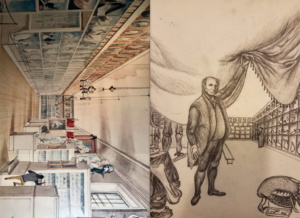
An illustration showing the interior of what the Peale Museum may have looked like in the 19th century, juxtaposed with a drawing of Charles Willson Peale, lifting a curtain to reveal his museum.
An illustration from “Flip Me,” a Goucher College student project.

Scary Story
By Tia Resham Cheema, Katie Chen, Marissa Grant, Dina Diani
An interactive website and digital ghost story!


Camera Obscura
By Will Kirby
A comprehensive photobook showing Camera Obscura techniques as employed at the Peale


Flip Me
By Alexis Liszewski
A beautifully drawn custom flip book, featuring the Peale and its patrons


Peale Center Project
By Maddy Romberger
A combination of drawings and photographs, covering the Peale’s long history and impressive architecture


(Peale)ing Pictures
By Camryn Agostino
Coming Soon!


Story of the Floor
By Melina Albornoz
Coming Soon!


Perspectives
By Vela Culbert
Coming Soon!

BootPrints: Immersive Performance 30 June 6pm

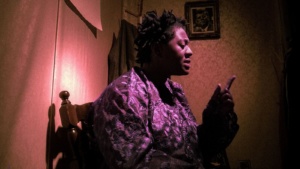
An African American woman in a purple shirt sits in a chair in a dark room, speaking to the audience.Join us at the Peale on Saturday, June 30 at 6pm for the final live performance of BootPrints, including a staged reading with chorus and the immersive exhibition, followed by a conversation between the playwright, Latonia Valincia-Moss and Angela Carroll of BmoreArt Magazine. A vegan tasting is included in the ticket price, and drinks can be purchased additionally during the event.

Tickets are $15 in advance and $20 at the door.

See the Peale at the Jonestown Festival Sun 24 June 12-4pm!

This Sunday join the Peale at the Jonestown Festival, an outdoor extravaganza featuring circus acts, an escape artist, stilt walkers, face painters, and more in Baltimore’s oldest neighborhood.

Sunday, June 24th, 12 pm to 4pm 

Lloyd St between Lombard and Baltimore, B’nai Israel Synagogue

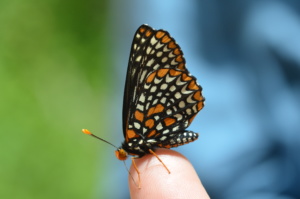
Visit the Peale’s table on Lloyd Street for butterfly puppet-making and storytelling activities inspired by our new pollinator garden!

“Standing Room Only” extended through July 1

“Standing Room Only,” the exhibition curated by Tiffany Jones of BootPrints, the play and film directed by Nate Couser, can now be seen at the Peale through July 1. At 6pm on Saturday, June 30, in addition to the exhibition, enjoy an Immersive Performance of the production including a staged reading with live chorus and conversation between the playwright, Latonia Valincia-Moss and Angela Carroll of BmoreArt Magazine. 

Tickets are $15 in advance/$20 at the door and include a vegan tasting. Drinks can be purchased additionally.

Self-guided visits to “Standing Room Only” are free and open to the public Thursdays, Fridays, and Saturdays 12-6pm and Sundays 10am-4pm. Advanced booking is recommended.

Bootprints: Standing Room Only at the Peale Museum is an Immersive Experience in Black Memory; review by Angela N. Carroll

Black Grandmothers: Labor, Lace, and Wide-Brimmed Hats

By Angela Carroll

“God specting womens to lay down and gurd up. Womens have to take boots on ‘deir chest and dress shoes, sneakers and cleats too. Women like carpet—all kinds of shoes gotta walk on womens.” – from Bootprints

Latonia Valencia’s dramatic play, Bootprints, is an unsettling but familiar narrative about death, family secrets, and the revelations of those who survive. Bootprints unpacks Black memory and the frustrations of younger generations who grapple with the histories, traditions, and secrets they have inherited.  The perpetuity of Black mourning, Black grandmothers, labor, lace and wide-brimmed hats. Silk and sore backs from working as housemaids, Gmama’s hands, Sunday mornings, all these memories come into focus when Gmama dies.  Her granddaughter Myeshia is left mourning her loss and remembering the impact of her grandmother on her life.

The play opens on Myeshia in conversation with her alternate personality Gingel as they determine what outfit to bury Gmama in.  Gmama had a vast collection of colorful suits and each marked a significant event in the women’s lives; miscarriages, molestation, wealth, abandonment, love, failed marriages, poverty. As Myeshia/Gingel and Gmama’s apparition sort through the suits, they share their memories aloud as epic choreopoems.  Like Ntzoke Shange’s timeless homage, For Colored Girls Who Have Considered Suicide When the Rainbow Is Enuf, Bootstraps uses color, fashion and domestic interiors as cues for the emotional and psychological states of its protagonists. The play honors and humanizes narratives about southern Black women.

Director Nate Couser and Curator Tiffany Jones reimagine the theatrical script as an immersive installation series, Bootprints Standing Room Only at the Peale Museum. The installations convert the second floor of the museum into surreal visualizations of Gmama and Myeshia/Gingels memories. Photographs, prints and collage works from Brianna Faulkner, Antonio McAfee, and I Henry Phillips are incorporated into and/or placed opposite the installations.

In all instances, Jones installations provide powerful imagery that enunciates key moments in the play and offer new perspectives about Black women’s lived experiences. Each installation tugs at the senses. Visitors can take lollipops or mints from any of the many candy dishes spread around the museum/Gmama’s house.  You may smell the sweet dense aroma of incense or the pungent funk of moth balls. You will hear the voice of Gmama, Myeshia and Gingel tell their own stories through looped audio projections. You will surely leave the experience inspired.

Read more…
“Moving Walls” reviewed by thINKing DANCE

Moving Bodies, Embodied Walls

by Andrew Sargus Klein

In a room damp with early summer humidity, the soloist’s slow pace approached a breaking point. Prone in the center of the floor, all torso, mantis-like, isolated limbs slowly unfolded, reached, paused. No air circulation, no score, a thin sheen of sweat over everyone, save for the soloist who captivated the audience as first one limb, then two, then all left the ground in a suspended geometry.

We were watching a kinetic sculpture compiled of wood slats, a piece of bannister, some pocket shutter, a chair leg, shoe molding, several varieties of hinge, and eye hooks. The creation was manipulated by two sets of hands holding black cord that ran through squeaking pulleys and connected to the eye hooks.

It was part sculpture, part puppet, part voice—the wood and metal breathed as if it were its own body. It transformed static materials beyond the mere connectibility of their individual parts, and it was a near-perfect culimination of a performance focused on the “human experience in relation to architecture” which questioned “concepts of stability.”

Moving Walls, set in the first two floors of the Peale Center for Baltimore History and Architecture, was a collaborative and site-specific effort in the truest sense of those terms. Five artists came together in an almost year-long generative process: Sidney Pink (movement), Noa    Heyne (filmography and sculpture), Sarah Smith (movement), Matthew Williams (movement), and Khristian Weeks (score).

Read more…