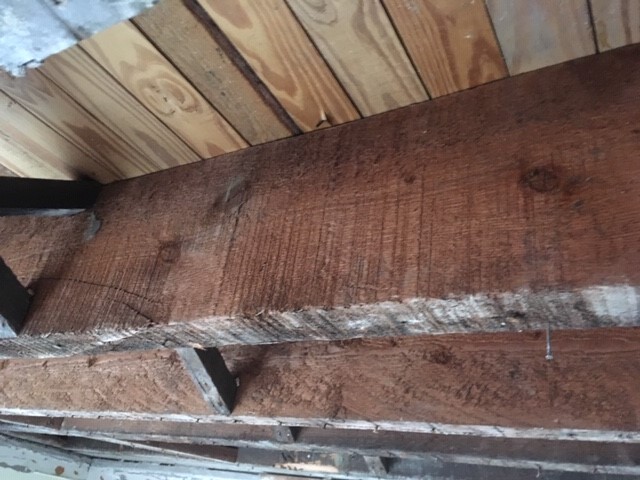
 Over the last few weeks, the Peale’s renovation team has made some intriguing discoveries as they removed a 20th-century ceiling. The image above shows straight cut marks on the room’s wooden joists, indicating that this joist was cut by a “sash-style” sawmill, and therefore, is as least as old as the 1830 conversion of the building into City Hall.
It’s possible that the joists could date to the original 1814 building; however, the team is cautious not to assign the joists to Rembrandt Peale’s original construction because records indicate that a large quantity of joists and framing lumber were purchased by the City as part of the 1830 adaptations undertaken when the Museum was converted into Baltimore’s first City Hall. “There’s a very good chance that much more of the original framing lumber survives than we previously thought. At the latest, these joists date to 1830,” said Jackson Gilman-Forlini, Historic Preservation Officer with the City of Baltimore.
Learn more about renovation work at the Peale from 1830 to the present in this interview with Gilman-Forlini, and stay tuned for more news and photos in this News section, on our Flickr page, and in our weekly emails!
With your support, such discoveries will continue to be made in the weeks and months ahead. We’ve raised $4.8 million to date to return this historic gem to public use, so are nearing the end of the Peale’s $5.2 million capital campaign! Any amount you can contribute will help continue our interior renovations to make the Peale a fully accessible home for Baltimore’s stories.