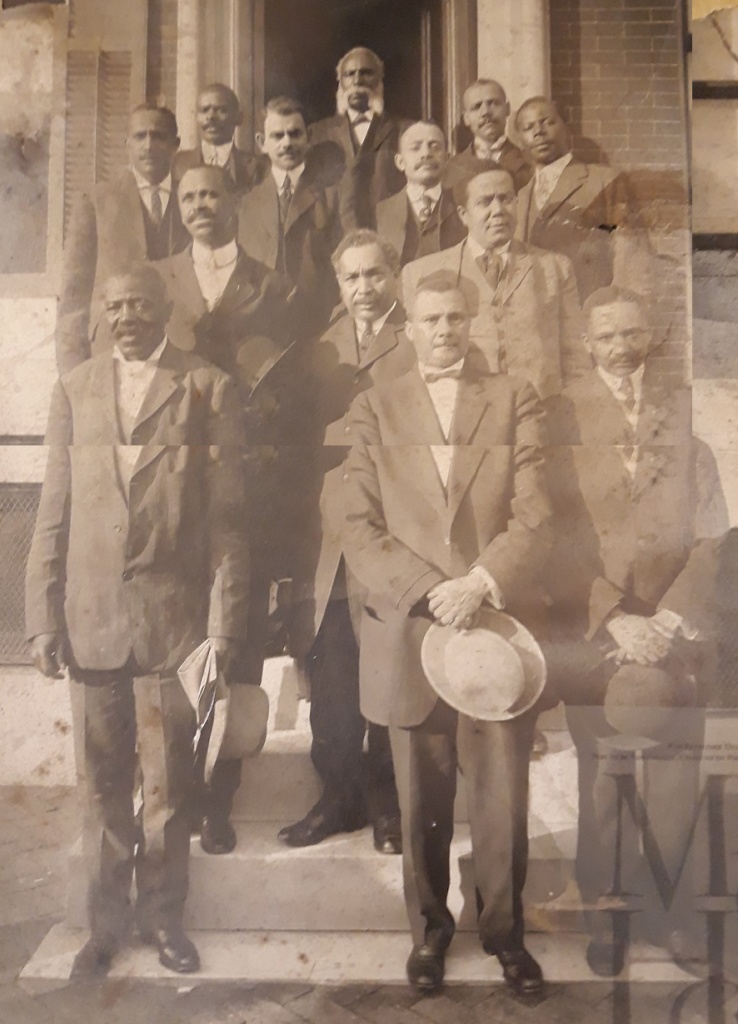
Male and Female Colored Grammar and High School No.1 at the Peale Center for Baltimore History and Architecture
Archival and Digital Resources
Compiled by Iris Leigh Barnes, Ph.D.
BIBLIOGRAPHY
PRIMARY SOURCES
“African American Records: Freedmen’s Bureau.” National Archives and Records
Administration. https://www.archives.gov/research/african- americans/freedmens-bureau.
Alvord, John Watson. Semi-annual Report on Schools for Freedmen: Numbers 1-10, January 1866-July 1870. New York, NY: AMS Press, 1980.
“The American Freedman. V.1-2 Inc. 1866-1867.” HathiTrust.
https://hdl.handle.net/2027/inu.32000003310127.
American Missionary Association Archives, Amistad Research Center at Tulane University, New Orleans, Louisiana.
“Baltimore. December 15th, 1864. Sir:- Your Attention Is Called to the Association Formed in This City for the Moral and Educational Improvement of the Colored People.” The Library of Congress. http://hdl.loc.gov/loc.rbc/rbpe.03101900.
“District of Columbia, Freedmen’s Bureau Field Office Records, 1863-1872,” database with images, FamilySearch (https://familysearch.org/ark:/61903/1:1:Q2QV- T6DV: accessed 9 April 2018); citing Military Correspondence, District of Columbia, United States, NARA microfilm publication M1902 (Washington, D.C.: National Archives and Records Administration, n.d.); FHL microfilm 2,424,783.
The Public School Law of Maryland, Passed … 1872, as Amended at the January Session, 1874. Baltimore: W.J.C. Dulany &, 1877. https://archive.org/details/bylawsrulesregul00maryrich.
The Public School Law, of Maryland, Passed at the January Session, 1872. Baltimore, 1872.
“Report: Maryland. State Board of Education: Free Download, Borrow, and Streaming.” Internet Archive. January 01, 1866. https://archive.org/details/report1869mary.
“United States, Freedmen’s Bureau, Records of the Superintendent of Education and of the Division of Education, 1865-1872.” FamilySearch. https://www.familysearch.org/search/image/index?owc=31SB- VZS%3A1556056502%3Fcc%3D2427894.
SECONDARY SOURCES
Butchart, Ronald. Schooling the Freed People: Teaching, Learning, and the Struggle for
Black Freedom, 1861-1876. Place of publication not identified: Univ Of North Carolina Pr, 2013.
Du Bois, William E. B. Black Reconstruction in America: 1860 – 1880. 1. ed. New York, NY: The Free Press, 1998.
Bentley, George R. History of the Freedmens Bureau.: University of Pennsylvania Press, 1955.
Fleming, G. James. “Racial Integration in Education in Maryland.” The Journal of Negro Education 25, no. 3 (1956): 273. doi:10.2307/2293436.
“The Freedmen’s Bureau.” EHnet. Accessed April 10, 2018.
https://eh.net/encyclopedia/the-freedmens-bureau/.
Fuke, Richard Paul. “The Break-up of the Maryland Union Party, 1866.” Master’s thesis,
1965. ——-. “The Baltimore Association for the Moral and Educational Improvement of the Colored People 1864-1870.” Maryland Historical Magazine, 1971, 369-404. http://msa.maryland.gov/megafile/msa/speccol/sc5800/sc5881/000001/000000/00 0264/pdf/msa_sc_5881_1_264.pdf.
——-. “Black Marylanders.” PhD diss., University of Chicago, 1973. Chicago: University of Chicago, 1973.
——-. Imperfect Equality African Americans and the Confines of White Racial Attitudes in Post-emancipation Maryland. New York: Fordham University Press, 1999.
——. “Land, Lumber, and Learning: The Freedmen’s Bureau, Education and the Black Community in Post-Emancipation Maryland.” In The Freedmen’s Bureau and Reconstruction, edited by Paul A. Cimbala and Randall M. Miller, 288-314. New York: Fordham University Press, 1999.
Gartell, John B. “Emancipated but Not Free: African Americans under the Post- Emancipation Apprenticeship System in Frederick County, Maryland 1864- 1870.” Master’s thesis, Morgan State University, 2009. Baltimore: Morgan State University, 2009. ProQuest Dissertations and Theses [ProQuest].
Gregory, Clarence Kenneth. “The Education of Blacks in Maryland: An Historical Survey.” PhD diss., Columbia University, 1976. New York: Columbia University, 1976. Accessed January 25, 2018. ProQuest Dissertations and Theses [ProQuest].
Low, W. A. “The Freedmen’s Bureau and Civil Rights in Maryland.” The Journal of Negro History 37, no. 3 (1952): 221-47. Accessed September 28, 2016. doi:10.2307/2715492.
Mills, Barbara. “Part IV: Education.” In “Got My Mind Set on Freedom”: Maryland’s Story of Black & White Activism, 1663-2000, 329-420. Bowie, MD: Heritage Books, 2002.
Myers, William Starr. The Maryland Constitution of 1864, by Williams Starr Myers. Baltimore: Johns Hopkins Press, 1901.
Myers, William Starr. Self-Reconstruction of Maryland: 1864-1867 (classic Reprint). S.l.: Forgotten Books, 2015.
Rose, Willie Lee. Rehearsal for Reconstruction. Oxford: Oxford University Press, 1964. “St. Paul UMC – MD.” (St. Paul UMC – MD). Accessed April 09, 2018. http://www.stpumcmd.org/history1800
Colored School at the Peale Center Online Resources
Compiled by Tonika Berkley, MAA
Black Rights and Black Citizenship in Antebellum Baltimore-African American Intellectual History Society
https://www.aaihs.org/black-rights-and-black-citizenship-in-antebellum-baltimore/
Free Negro Education Newspaper Clippings-1848-1905
http://aspace.library.jhu.edu/repositories/3/resources/384
John F. Slater Fund for the Education of Freedmen correspondence (1882)
http://aspace.library.jhu.edu/repositories/3/archival_objects/173473
Digitized Baltimore City Directory
http://lib.guides.umd.edu/c.php?g=327119&p=2195209
Maryland Historical Society-Guide to African American Resources
https://www.mdhs.org/sites/default/files/African_American_Resources.pdf
Internet Archives
Research Repositories for African American Education in 19th century Baltimore
Baltimore City Archives
Coppin State University
Enoch Pratt Free Library (African American Room, Maryland Room)
Lillie Carroll Jackson Museum
Maryland Historical Society (Baltimore City Teachers Association Records-1849-2001)
Morgan State University
Reginald F. Lewis Museum of Maryland African American History and Culture
Smithsonian Institution- National Museum of Maryland African American History and Culture
University of Baltimore-Special Collections
Bethel AME Church
Lovely Lane Church Archives
Sharp Street AME Church
St. Francis of Xavier Church
St. James Episcopal Church
Union Baptist Church (archives)
-end-
Meet Our Research Team!
Tonika D. Berkley, MAA, Research Coordinator and Curator, Male and Female Colored Grammar and High School 1 at the Peale Center Research Project
Ms. Berkley is a museum educator, working for various museums in Baltimore, Washington, DC, and Pennsylvania including the Walters Art Museum, the Baltimore Museum of Industry, The Reginald F. Lewis Museum of Maryland African American History and Culture, and the Penn Museum. She has also assisted with developing museum exhibitions for the Maryland Historical Society, the Reginald F. Lewis Museum and the Peale Center for Baltimore History and Architecture. She was trained as a historical archaeologist, primarily focusing on 19th century plantation archaeology in Prince Georges County, Maryland. Ms. Berkley was a former Middle School Social Studies teacher for Harford and Baltimore County Public Schools. She earned her Bachelor’s degree from UMBC in Sociology/Anthropology, her Master’s Degree in Applied Anthropology from the University of Maryland College Park and her teaching credentials from University of Notre Dame of Maryland. She is currently pursuing her Masters in Arts Administration and Museum Leadership from Drexel University.
Dr. Iris L. Barnes, Curator, Lillie Carroll Jackson Museum
Dr. Barnes is currently Curator of Morgan State University’s Lillie Carroll Jackson Civil Rights Museum (LCJM) in Baltimore. She is also the Executive Director of Hosanna School Museum in Darlington, Maryland. Hosanna is a restored Freedmen’s Bureau School, founded in 1867, and was the first public school for African Americans in Harford County. In 2018, Dr. Barnes was appointed to the Governor’s Office of Community Initiatives’ Maryland Commission on African American History and Culture. She earned her PhD in History at Morgan State University and her Master’s degree in Museum Studies and Historical Preservation, also from Morgan.
Dr. Mary Ellen Hayward, Architectural Historian, Preservation Consultant and Museum Consultant
After working for many years as the maritime curator at the Maryland Historical Society, Dr. Mary Ellen Hayward has worked as an independent preservation and museum consultant since 1996. Dr. Hayward helped create, and acts as curator of the Irish Railroad Workers Museum at 918-920 Lemmon Street. She has prepared fifteen successful National Register Historic District nominations for various parts of Baltimore City and identified those buildings still standing in Fells Point that were there during the War of 1812. Dr. Hayward is the author of several books on Baltimore architecture: ‘Baltimore’s Alley Houses: Homes for Working People Since the 1780s’, ‘The Baltimore Rowhouse’, with Charles Belfoure, and Editor, with Frank R. Shivers, Jr. of ‘The Architecture of Baltimore, An Illustrated History’. Dr. Hayward is a member of the Board of Directors of the Peale Center for Baltimore History and Architecture.
Lisa Rose Lamson, Lord Baltimore Research Fellow, Maryland Historical Society
Lisa Rose Lamson is currently a PhD Candidate in American History at Marquette University in Milwaukee, Wisconsin under the direction of Dr. James Marten. She is currently a teaching fellow with the Marquette history department and a Lord Baltimore Research Fellow through the Maryland Historical Society and has received research support from the McNeil Center for Early American Research, the Center for Transnational Justice in Marquette University’s Political Science Department, the Graduate College, and the History Department.
Dean Krimmel, Interpretive Planner and Exhibit Developer
Dean is a consultant to cultural nonprofits with nearly 40 years’ experience in the public history and museum fields. His specialties include interpretive plans and programs, history exhibitions, research and documentation, and communicating with diverse public audiences. Dean is a member of the Peale Center board and former curator at the Baltimore City Life Museums. He brings to the Colored School Project a deep love of Baltimore history, the African American experience, and the history of Rembrandt Peale’s landmark 1814 museum building.
Dr. Brian Morrison, Founder & President, The William J. Watkins Sr. Educational Institute, Inc.
Dr. Brian C. Morrison is the Founder and President of the William J. Watkins, Sr. Educational Institute which focuses its work on improving educational outcomes for African American students. He earned a doctorate degree in History from Morgan State University. His dissertation, “African American Educational Efforts in Baltimore Maryland during the 19th Century”, examines how African American Baltimoreans used education as a source of cultural capital and pathway to freedom. In his more than 30 years as a public school educator, Dr. Morrison has written African American History curriculum, created and facilitated professional development workshops on various topics in African American History and Culturally Responsive Pedagogy, and has been a classroom social studies teacher and school administrator.