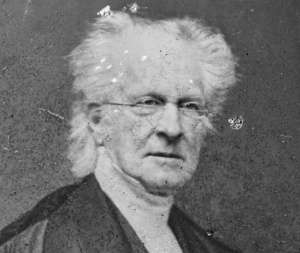
Q. Which American photographer captured this early image of Rembrandt Peale, the founder of the Peale Museum?
A. This photograph of Peale was taken in 1860, when he was 82 years old. Peale died on October 3 of that year, in Philadelphia. The man who captured his likeness was Mathew Brady (1822-1896). Brady opened a studio in New York in 1844, where notable figures like Abraham Lincoln, Walt Whitman, and P. T. Barnum were photographed. He is best known for his shocking images of the Civil War, capturing scenes of horror and distress the likes of which had never been seen by Americans. The prolific Brady took more than 10,000 photographs from that period.
According to the Smithsonian’s American Art Museum, Brady “directed a large staff of photographers from his Washington, DC headquarters, which necessitated his skills as a historian, perhaps his greatest contribution to the Civil War . . . Like most photographers during the war, Brady rarely photographed actual battles. Cumbersome camera equipment and slow exposure times made it difficult to capture action. Instead, they focused on the aftermath of the battle, military portraits, and scenes of camp life . . . His picture of a Northern soldier being aided by another played to the collective trauma of mid-nineteenth century American households, most of whom . . . had suffered the loss of a relative or friend.” Despite his incredible contributions to American art and history, Brady died penniless in 1896.
Photo: Public Domain, courtesy Wikipedia; the original can be found at United States Library of Congress, Prints and Photographs division under the digital ID cwpbh.02797