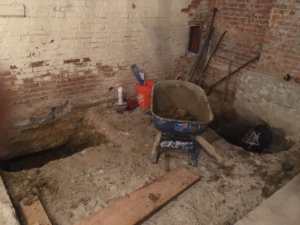
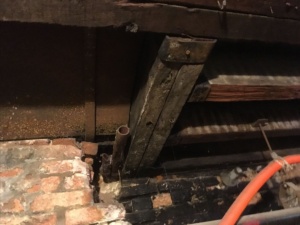
 “Today really is the pits.” That was the clever subject line of an email chain last week between Peale board member William “Chick” Chickering and Jackson Gilman-Forlini, City of Baltimore Historic Preservation Officer, about the digging of the Peale’s elevator pit. Renovation work continued last week as the team exposed original brickwork and early 19th c. joists. Areas for the cafe and elevator shaft have also been laid out in the building.
According to Gliman-Forlini, the interior walls, particularly around the foundation, “are all original to the best of anyone’s knowledge. There’s no record of these having been replaced at any time.” Also original to Rembrandt Peale’s building are the stove niches on the second and third floors, which have now been uncovered.
On the other hand, “the façade was replaced in 1930 with salvaged brick from an 1830s townhouse on the corner of Saratoga and St. Paul that was selected because it closely matched the color, size, and texture of the original façade brick. The exterior wall along Watchhouse Alley was also replaced in 1905,” most likely with new brick at that time. Other features, like the brick wall that bisects the “East Wing” first floor was added in 1930. The flag stone pavers in the current garden date to that era as well. Gilman-Forlini notes that they “originally served as the pre-1930 toilet partitions!”