Rembrandt Peale’s 1816 “Ring of Fire” reinterpreted for the 21st century by light artist Sean Michael Kenny at the Peale Center for Baltimore History and Architecture
Ceremonial lighting Wednesday, April 24, 2019, 5:30-8:30 p.m.
Kenny’s “Ring of Fire” will be inaugurated at a special open house
FREE, but RSVP encouraged: http://bit.ly/Peale24April2019
RSVP: http://bit.ly/Peale24April2019
Web: https://old.thepealecenter.org/events/night-of-light
The Night of Light will also include:
- Demonstrations of Rembrandt Peale’s Magic Ring of Fire, invented in 1816
- ILLUMINATED Exhibition on the history and safety of gas & light in Baltimore and beyond…
- Time Travel Tours to Rembrandt Peale’s study in 1819
- Performances & Presentations from local artists and experts
- ‘historically hysterical’ exhibition by Maryland Institute College of Art’s (MICA) Exhibition Development Seminar (EDS)
Light artist Sean Michael Kenny (SMKLight) is collaborating with the Peale Center for Baltimore History and Architecture to help people “see Baltimore in a new light” by illuminating Baltimore’s 19th origins as “Light City” and bringing greater visibility to the city’s diverse cultural stories and voices today. Kenny’s latest work for the front porch of the historic Peale Museum building on Holliday Street in downtown Baltimore reimagines the “Magic Ring of Fire” gaslights that Rembrandt Peale first demonstrated in his museum in 1816. The new technology so enthralled audiences of the day that Peale and his partners won the contract to supply gas streetlights throughout the city of Baltimore, making it the first city in America to be lit by gas and earning it the nickname, “Light City.” The Baltimore Gas Light Company that Peale founded is now known as Baltimore Gas and Electric (BGE), an Exelon company and, at 202 years old, one of the oldest continually-operating companies in the world.
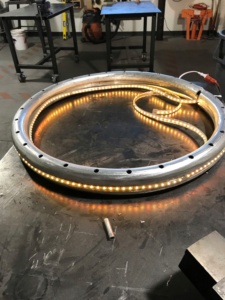
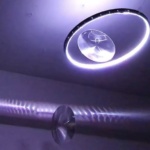
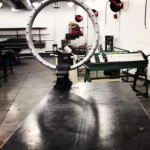 Inspired by Peale’s gaslight innovations, the “Ring of Fire” artwork by Sean Michael Kenny aims to capture the curiosity and wonder that was first experienced by viewers marveling at the original chandeliers that illuminated the Peale Museum more than 200 years ago. Using contemporary green and bird-friendly LED technology, Kenny’s modern chandelier also plays authentic Baltimore stories from the Peale Center’s Be Here: Baltimore program, turning the historic museum into a “talking building” that helps new narratives of the city be heard. Kenny’s interpretation of “Ring of Fire” begins with a metal rim, illuminated by individual LED lights flanking both the inside and outside to echo the openings in the original hoop where Peale’s “pearls” of gas light burned. Finally, the work features a speaker that plays stories of the city told by the people who know it best, as well as stories from the history of the Peale and its many innovations as the first purpose-built museum in the U.S., as the birthplace of BGE, as Baltimore’s first City Hall, and as the first public school to offer a secondary school education to African Americans in the state of Maryland.
About Sean Michael Kenny
 As a light artist, Sean Michael Kenny utilizes various optics to create multi-dimensional work which is described as “The Modality,” referring to a particular mode in which something is expressed or experienced. This expression creates a new universe as light dances throughout the space, seemingly out of nowhere, extracting what is unseen and making it visible. Kenny’s work was featured in Light City’s 2018 Neighborhood Lights for the Bromo Arts District at the iconic Bromo Seltzer Tower. He will also display his “Trinity – Light Chimes” project at Burning Man 2019 at the Whiskey and Dust camp. Learn more at http://www.smklight.com/
About the Peale Center for Baltimore History and Architecture
In 1816, Rembrandt Peale began illuminating his Baltimore museum’s galleries with gaslight chandeliers. Up to 100 “gems of light” burned in a metal circle suspended overhead and fueled by gas made from burning pitch. The new technology both enabled Peale to keep his doors open at night, attracting more visitors and revenue after dark, and also served as an attraction itself. People had never seen such bright interior lights before. Those who could not afford the price of admission gathered outside to gawk at the brilliance of the light spilling out of the windows. Excitement about Peale’s “Magic Ring of Fire” led to his founding the Baltimore Gas Company, which by 1817 had begun installing gas street lights throughout the city. Thanks to Peale’s pioneering efforts, Baltimore was the first city in the U.S., and among the first in the world, to be lit by gas, earning it the nickname, “Light City.” The company Peale founded is now known as BGE, one of the oldest continuously-operating companies in the world.
Currently renovating the historic Peale museum building, the mission of the Peale Center for Baltimore History and Architecture is to help people see Baltimore in a new light by working with the city’s culture keepers and storytellers to create a more inclusive cultural record of the city. To date, more than 1400 authentic stories of the city have been recorded and shared on a range of free and open platforms, including the “Be Here Stories” app and live storytelling programs at the Peale Center and other partner sites around the city. With these efforts, the Peale aims to help change the narrative about Baltimore and enable it to become known and appreciated worldwide for its rich history and the full range of its diverse people and places today.